Bamboo is not a wood, and your spec sheet should say so
Bamboo is technically a grass, and the fact is commercial rather than trivia. Bamboo kitchen tools are not carved from solid timber the way a beech spoon is. The usual construction laminates strands or strips of bamboo into panels under heat and pressure with adhesive, and the tools are then shaped from that panel. This changes what a buyer is actually specifying: alongside shape and finish, you are buying a laminated construction and the adhesive system behind it, and both belong on the spec sheet in writing.
The distinction also disciplines your product copy. Calling bamboo utensils wooden in the casual marketing sense is common, but the specification you sign and the claims you print should describe what the product is: laminated bamboo, not solid wood. Buyers who keep that line clean avoid trouble with reviewers who know the difference and with compliance reviewers who certainly do.
The look and the material behavior
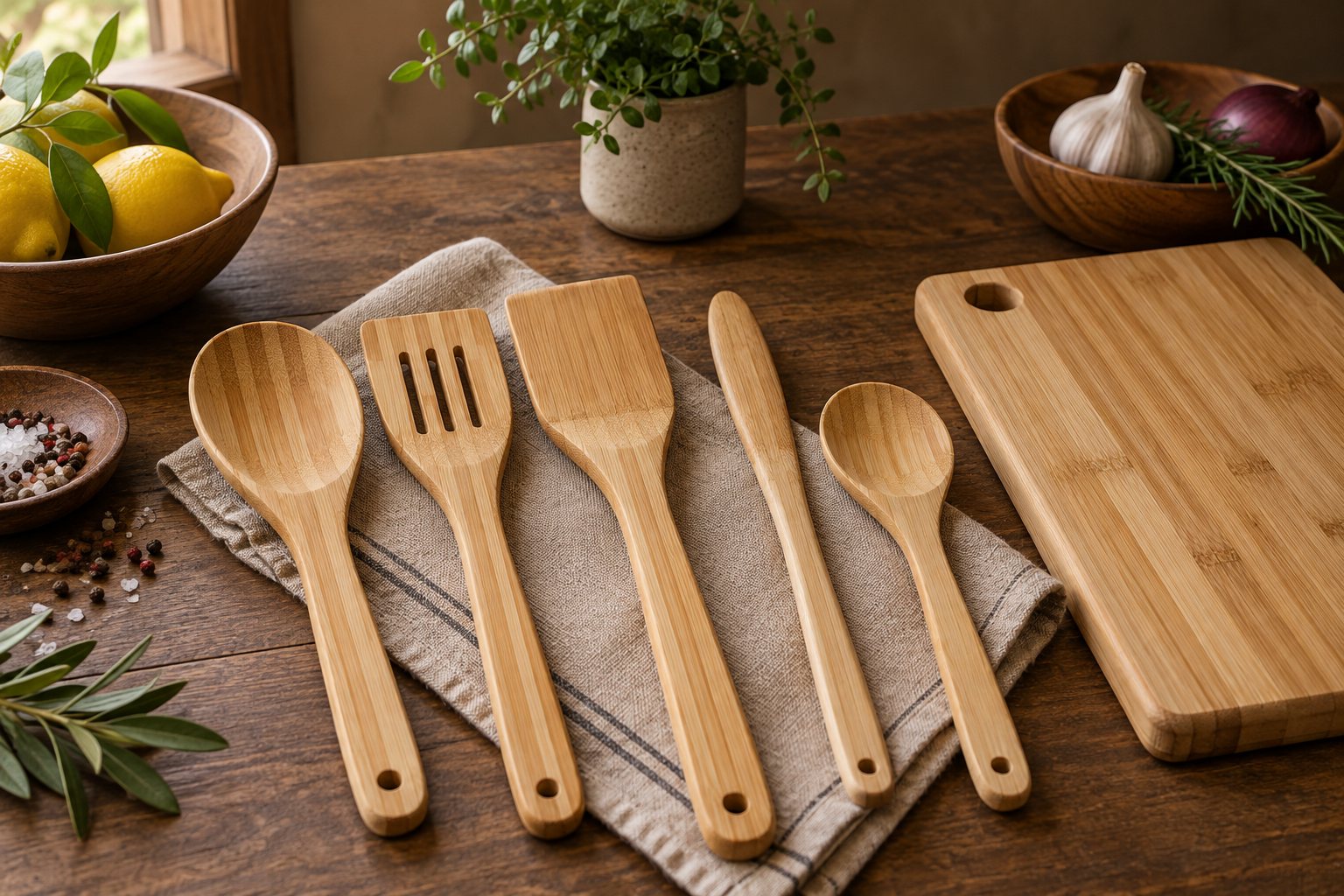
Bamboo's appeal is easy to see. The color is light and clean, the surface shows a fine striped pattern from the laminated strands, and the material is hard, so working edges hold up in daily kitchen use while the piece stays lighter in the hand than most solid-wood equivalents. That combination, hard at the working end and light overall, suits salad servers, tossing spoons, kids' tools and long-handled pieces where weight is genuinely felt.
What bamboo does not offer is solid-timber character. There is no dramatic grain that develops differently in every piece, no tone depth like walnut or acacia; the laminated look is uniform by design. Buyers who want visible natural variation and a material story should weight acacia or olive wood. Buyers who want a clean, modern, consistent look at a friendly weight are bamboo's natural audience, and for them the uniformity is a feature, because every unit matches the listing.
The adhesive question to ask every supplier
Because laminating requires adhesive, one question separates a professional bamboo program from an improvised one: which adhesive system is used, and what documentation does the panel carry? Ask it of every supplier you evaluate, and get the answer in writing before sampling, not after the bulk order. Adhesives are where food-contact compliance questions concentrate, so the documentation matters whether your market is the US, where finishes and substances for food contact fall under FDA rules, or the EU, where buyers often ask for the stricter German LFGB framework. California Proposition 65 adds a further layer, since warning obligations can depend on finishes and adhesives and should be assessed with your compliance adviser. The compliance page summarizes what each framework covers and who handles what, and our adhesives note lists the questions to put into your RFQ.
Supply, and the bamboo-replacing-plastic context
China's bamboo processing industry is deep and mature. Zhejiang province hosts major bamboo processing centers, Anji among them, producing bamboo cutlery and household items at scale, and the workshops we coordinate draw on that network. Domestic policy and industry initiatives actively encourage bamboo products replacing single-use plastic, an effort often summarized as bamboo replacing plastic, and the effect for buyers is sustained investment in processing capacity and tooling. Treat that as a supply-side fact useful for planning, not as a claim to print on your box.
Claims discipline deserves its own paragraph, because bamboo attracts green marketing. Bamboo is a fast-renewing plant, and that part is true and worth saying. Finished bamboo panels, however, involve adhesives, so broad claims such as eco-friendly or compostable need qualification to match the actual product, in line with how the FTC's Green Guides treat environmental marketing claims. The widely reported FTC bamboo labeling actions concerned textiles sold as made from bamboo that were in fact viscose or rayon; for hard goods like utensils that specific labeling rule does not apply, but the underlying duty does: describe the product honestly. The factual description, laminated bamboo with a documented adhesive system and a food-contact oil finish, is both compliance-minded and more persuasive than vague green language. Our eco claims note covers the qualification rules.
Where bamboo fits a program
Bamboo earns its slot on hard working surfaces, light weight, a clean modern look and a value-to-mid price position. Typical fits include salad servers and tossing tools where weight matters, kids' lines, promotional sets with large engraving areas, and everyday ranges where consistency across units matters more than material drama. It also pairs well in mixed assortments: bamboo for the daily-use pieces, solid wood for the character pieces that carry shelf appeal. For premium positioning, solid wood tells the story better; for friendly-weight daily tools at scale, bamboo is genuinely competitive. The bamboo versus wood comparison covers the decision in more depth.
MOQ, sampling and lead time reference
| Item | Typical reference range | Notes for bamboo |
|---|---|---|
| MOQ, stock shapes | From about 500 pcs per style | Existing spatula, server and spoon patterns |
| MOQ, custom shapes | Typically 1,000+ pcs per style | New tooling amortizes setup over the order |
| Stock sample | About 3-5 working days | Ask for adhesive documentation with it |
| Custom sample | About 7-15 working days | Logo, finish and packaging on your shapes |
| Bulk production | Typically 30-45 days after approval | Panel supply is the schedule variable to check |
These are typical reference ranges for the category, not a quotation for your program. The MOQ, sampling schedule and bulk lead time for your bamboo program are confirmed in writing before any deposit is paid, and what moves the numbers is explained on the MOQ and lead time page.
What to send the desk
Your market, since it decides which food-contact frameworks matter, plus reference photos, a quantity range per style and whether stock shapes are acceptable. The desk replies with the bamboo route, a reference MOQ, a sampling plan and the adhesive documentation to collect, all in writing. Send a bamboo brief, or compare materials on the wood library page first.