What quality means in solid wood
Wooden utensils are judged by touch before they are judged by eye. A customer picks one up, runs a thumb along the handle, and knows within a second whether it was finished with care. That is why wooden utensil quality control concentrates on a handful of physical facts, sanding, dryness, structural soundness and honest appearance, rather than on paperwork. The desk applies these checks on every program, and this page explains what each check looks at, when it happens, and what you receive as evidence afterwards.
The checks, in the order they happen
- Sanding smoothness. Every sampled piece is drawn across a bare hand and inspected at edges, bowl rims and handle transitions. Any splinter or rough edge fails the piece.
- Moisture control. Pieces are checked for adequate dryness before they are packed, because sealing damp wood into a carton invites movement and cracking in transit.
- Crack and split check. Sampled pieces are examined for cracks at the handle neck, bowl and end grain, the three places stress concentrates.
- Oil coverage. The food-contact oil finish is checked for even coverage, with no dry patches or sticky residue.
- Engraving conformance. Marked pieces are compared to the approved artwork proof for depth, size, position and spelling.
- Carton drop handling. Packed cartons are handled and checked so the packing spec survives the freight journey, not just the bench.
Sanding and splinter checks
Sanding is where perceived quality is won or lost, which is why it is specified as a sequence through successively finer grits rather than a single pass. The pass standard is tactile: the surface must feel smooth to a bare hand with no splinters, no rough edges and no fuzzy grain raise. Inspectors pay particular attention to the places hands actually travel, the bowl rim of a spoon, the shoulders of a spatula, the transition where a turned handle meets the shaft. A piece that passes the eye test but fails the hand test is a reject, and a pattern of failures sends the run back to the sanding stage rather than forward to packing. Our production process page shows where sanding sits in the sequence.
Moisture control before packing
Wood that leaves the bench too damp will move later: it can crack along the grain, loosen a handle fit or grow surface mold inside a sealed carton. So dryness is checked before packing, not after arrival. The desk does not quote a single universal moisture number here, because the appropriate level depends on species, piece thickness and destination climate; the moisture condition your program will be checked against is confirmed on the spec sheet, in writing. What matters for you as a buyer is that the check exists, that it happens before cartons are sealed, and that a failure at this stage stops the run instead of becoming a claim in your warehouse. The underlying physics are explained in our note on moisture content in wooden utensils.
Crack and split checks
Cracks almost always start where geometry concentrates stress: the neck of a spoon handle, the junction of bowl and shaft, exposed end grain on a board. Inspectors examine those zones on every sampled piece under good light. Hairline splits that would open in a kitchen are caught here, along with internal flaws revealed by a change in sound or surface. Pieces that fail are removed from the run; the reject pattern is recorded, because a cluster of cracks in one corner of a batch points back to a blank or drying problem worth fixing at the source rather than sorting out piece by piece.
Grain variation judged against the golden sample
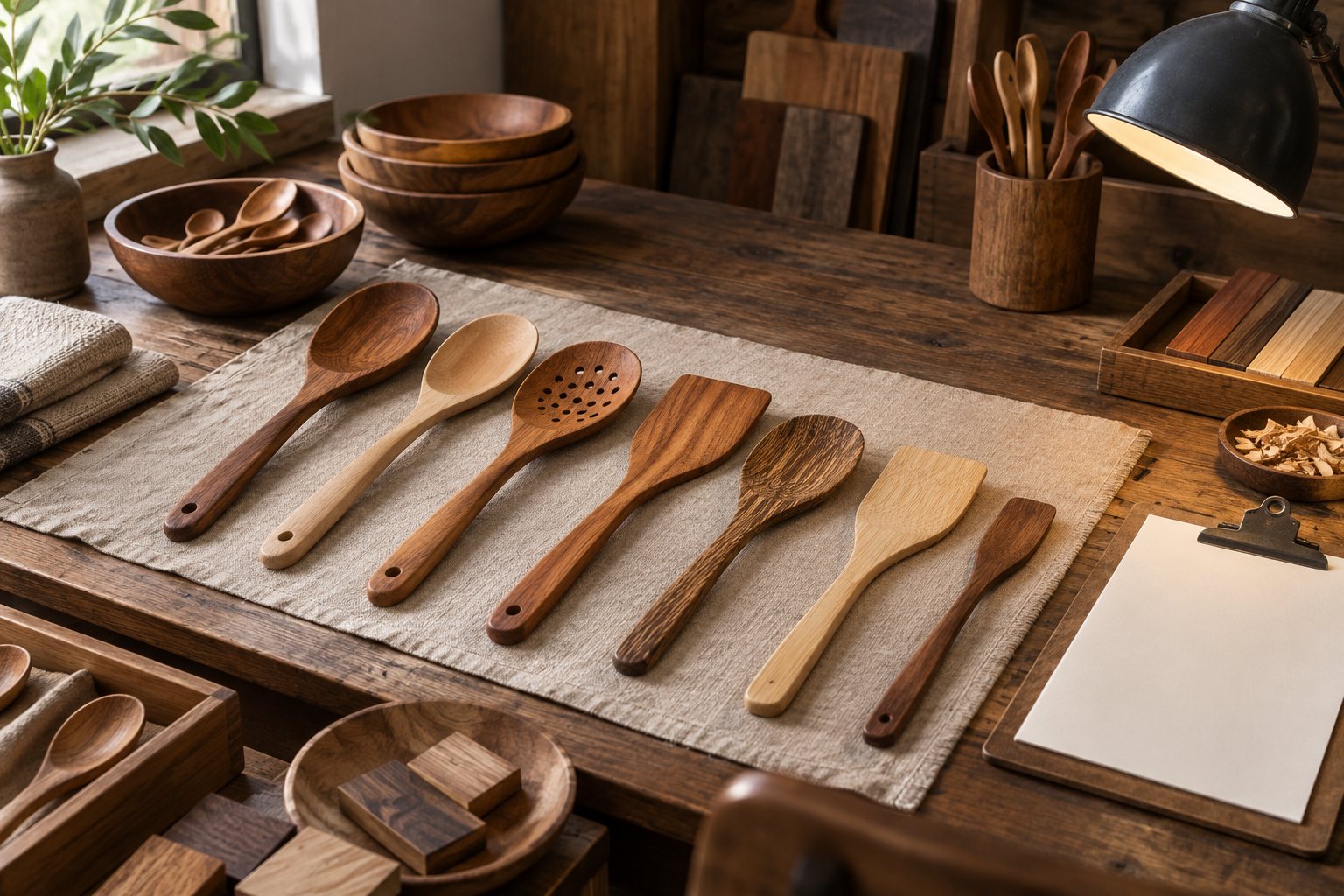
Solid wood varies. Two acacia spoons from the same carton can look like different products, and even pale beech shifts in tone between blanks. That variation is a property of the material, not a defect, so it is managed with a golden sample: a physical piece, approved by you before bulk, that defines the acceptable range of grain, tone and finish for the whole run. During checks, production pieces are compared against the golden sample rather than against a photograph or a memory. Anything outside the agreed range is pulled; anything inside it ships, even if no two pieces are identical. This single discipline prevents most end-of-production disputes, and our note on grain and color variation explains how to set expectations with your own customers.
Engraving proof approval
Engraved marks are checked against the artwork proof you approved, for depth, size, position and, not least, spelling. The proof round happens before bulk starts, on the private label page, so the inspection stage is a conformance check rather than a design discussion. A mark that drifts in position across a batch, or burns darker on one species than the proof showed, is treated as a finding and corrected before packing.
AQL sampling, in plain terms
Nobody inspects every piece in a run of thousands, and inspecting all of them would not even be the point. Instead, inspection works on sampling: a defined number of pieces is drawn at random from the batch and checked, and the batch passes or fails according to acceptance numbers agreed in advance. This is the AQL concept as used in general inspection practice. The desk does not impose one fixed level for all programs; the sampling plan and acceptance levels are agreed per order, in writing, before production, because a gift-channel program and a cookshop wholesale reorder may justify different strictness. What does not change is the discipline: the plan is fixed before inspection begins, and neither the workshop nor the desk loosens it mid-run.
What reports buyers receive
| Report | When | What it contains |
|---|---|---|
| Golden sample approval record | Before bulk | The approved physical standard and the variation range it defines |
| Artwork proof approval | Before bulk | Approved engraving artwork with depth, size and position |
| Inspection report | During and after production | Quantities checked, findings by check type, photos, pass or fail against the agreed sampling plan |
| Packing confirmation | Before shipment | Packing spec conformance, carton marks and counts |
Reports go to you as they go to us, so the same facts sit in front of everyone. If a finding appears, the written remedy terms agreed for the program decide the response, re-sorting, rework or remaking, and the cost of that response follows the same written terms. Nothing is negotiated from scratch after the fact, which is the quiet advantage of agreeing remedy handling up front.
Where the desk fits
The workshops run their own in-process checks; the desk verifies that the checks happened, reviews the evidence and spot-checks against the golden sample. The division is deliberate: the workshop owns the making, we own the verification and the paper trail. That structure, and the reference calendar around it, are set out on the MOQ and lead time page. If you want the checks translated into a spec you can hand to your own team, or you are comparing desks, our overview note on quality checks for wooden utensil orders is the short version, and the sanding QC note goes deeper on the check that fails most often. When you are ready to define your program's plan, send a brief.