Why kitchens make good corporate gifts
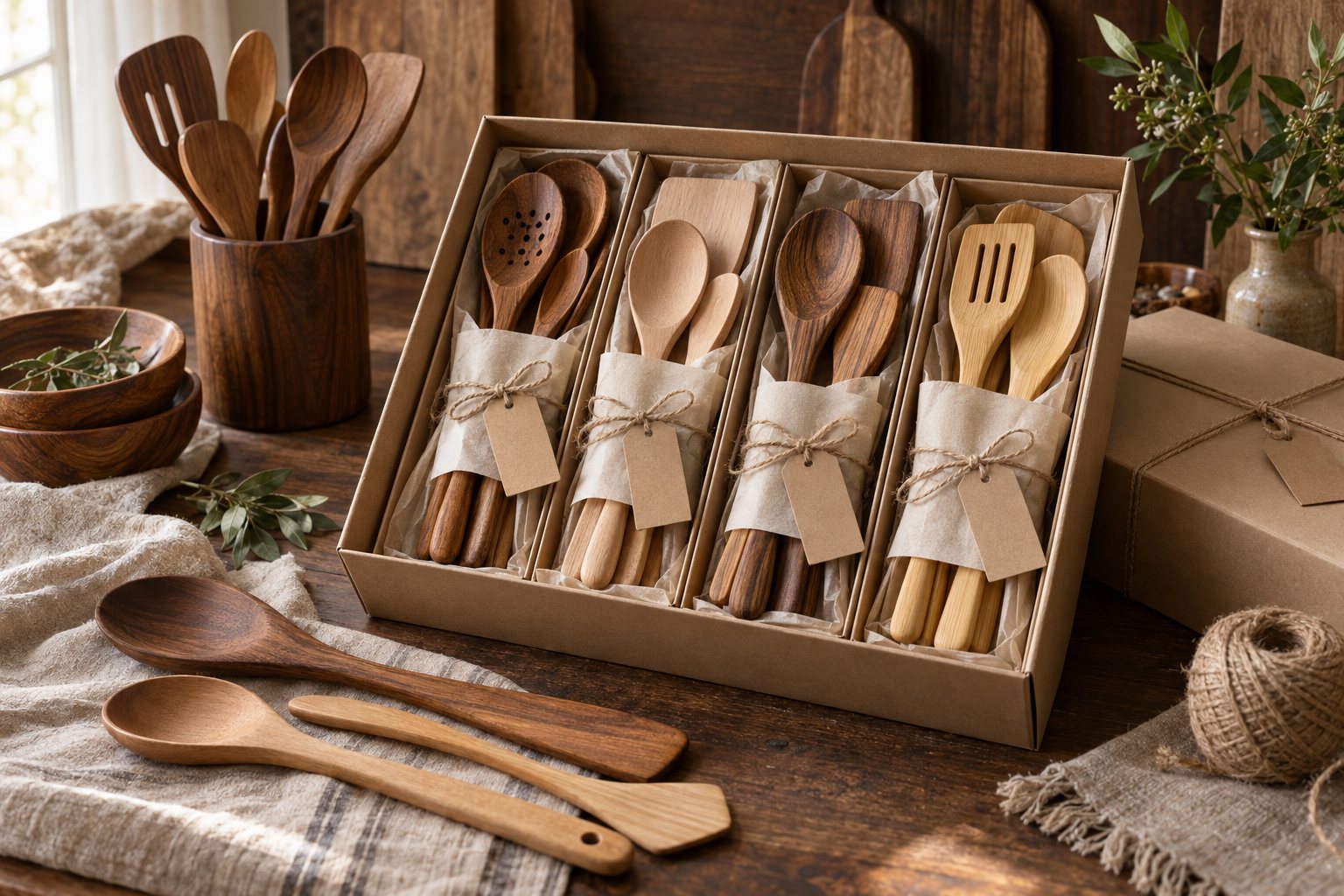
A corporate gift competes with a drawer full of previous corporate gifts, and most of them lose because they are generic the moment the event ends. Kitchen tools behave differently: they are used daily, they sit in view of family and guests, and a warm, well-finished wooden set carries none of the disposability that undermines the gesture. An engraved set says the giver thought about the recipient's home, not just their inbox. That is the honest pitch for engraved wooden gifts in a corporate program, and it is why the category works for client thank-yous, employee milestones, onboarding boxes and conference hospitality alike.
What a corporate program contains
| Element | Options | Where it is settled |
|---|---|---|
| Set composition | 3-4 piece essentials, 5-6 piece core, or a cooking set plus salad pair | Brief stage, sized to budget and occasion |
| Species and finish | Teak or walnut for prestige; beech for volume; food-contact oils | Brief stage, confirmed on the spec sheet |
| Engraving | Client logo, event mark, or recipient name | Artwork proof, approved before production |
| Packaging | Individual gift box, printed sleeve, care card | Sample round, alongside the tools |
| Delivery | Bulk to one address, or cartoned for onward distribution | Order confirmation, in writing |
Two of these elements deserve early attention. Engraving artwork changes per project, so every corporate brief is its own proof round; and individual packaging turns a bulk order into a gift at the moment of handover, which is usually the reason the program exists at all.
Artwork handling for corporate buyers
Corporate artwork arrives in every state of readiness, from polished brand guidelines to a logo in a spreadsheet footer. The desk normalizes it: vector files are requested where available, the mark is evaluated for engraving suitability, solid shapes with clear separation read best, and placement is proposed on the actual shapes. The artwork proof then records what will be burned, where, at what size and depth, and the client signs it off before production. Personalization, a different name on each handle, is handled as its own artwork round with the name list finalized before proofing, because a name corrected after engraving is a piece remade. The method and its workflow are covered in the engraving guide.
Individual packaging
A corporate gift ships twice: once to the client or the office, and once more, socially, into the recipient's kitchen. Packaging serves both trips. A rigid gift box with a fitted insert protects the set through bulk distribution and hands it over with weight and intent; a printed sleeve with a care card suits lighter programs and larger volumes. Each unit should arrive ready to hand over, which means the gift box carries the giver's mark, not the maker's, and the engraving inside does the personal work. Branding and box options are detailed on the private label page, and packaging choices belong in the first sample round, not the last week.
Timelines for gifting seasons
Gifting programs are planned backwards from the handover date, and the honest arithmetic is: bulk production typically runs 30-45 days after sample approval, and a custom sample with engraving and packaging takes about 7-15 working days, with transit on top; all figures are typical reference ranges, confirmed in writing for each program. Year-end gifting therefore concentrates orders into a narrow production window across the whole industry, and programs that brief late compete for workshop slots with everyone else doing the same. The workable habit is to start the artwork conversation one full production cycle before the season, approve the golden sample early, and hold the delivery date as the fixed point everything else serves. Calendar mechanics sit on the MOQ and lead time page.
Choosing shapes and species for the occasion
Composition follows the occasion more closely than the budget does. Onboarding programs favor three-piece beech essentials, light enough to mail and useful enough to survive a first job. Client thank-yous and milestone gifts move up to five-piece teak or walnut sets, where tone and weight do the talking before the engraving is seen. Hospitality openings often take a mixed brief, cooking tools for the kitchen team and a salad pair for the front, unified by one species and one finish so the gift reads as one thought. None of these are rules; they are the patterns programs settle into, and each is quoted on its own terms. Shape selection for gifting follows the same logic as retail, with the spoon guide and spatula guide carrying the detail.
Reorders and the second gifting year
The second year of a corporate program looks nothing like the first, and that is a compliment. The masters exist, the engraving setup is on file, and packaging is a reprint rather than a design project, so the calendar shrinks to production and transit. What changes is the artwork conversation: logos persist, event marks and dates refresh, and personalization lists grow as the program succeeds. Buyers who archive the approved artwork proof, the golden sample reference and the final name list with the desk find the second year is mostly a purchase order. Programs that skip the archive rebuild their own history, and the difference shows up as schedule risk in exactly the weeks a gifting calendar has least slack to give.
What to send the desk
- The occasion, the recipient count and the handover date.
- Set composition preference, or a budget direction to compose against.
- Species and finish preference, if any.
- Logo files and any personalization list, with its status.
- Packaging ambition: gift box, sleeve, care card.
Corporate programs are quoted per program, and the earliest briefs get the calmest calendars. Send the occasion brief and the desk will return composition options, a proof plan and written terms in one reply.