Different buyers, different programs
Wooden spoons wholesale does not mean one thing. A cookshop needs a tight, characterful range that turns on a small floor. A boutique kitchen brand needs a private-label line that looks like nobody else's. An e-commerce seller needs parcel-friendly sets that survive the courier. A distributor needs depth in reliable movers at clean price points. A hospitality group needs durable, brandable tools in quantity. The buying desk treats these as different programs with different shapes, species and packaging, even when the underlying spoons are the same, and this page shows how each route is assembled and what to confirm before the first order.
Start from a stock program
| Buyer type | What the program needs | Typical entry route |
|---|---|---|
| Cookshop or boutique retailer | Distinctive pieces, gift-wrappable, quick turns | Stock shapes in acacia or teak with printed sleeves |
| Kitchenware brand (private label) | A cohesive line with consistent finish and boxes | Stock shapes, engraved logo, private-label cartons |
| E-commerce seller | Sets that parcel well and photograph consistently | 5-7 piece sets in beech or teak with close-fitting cartons |
| Distributor | Depth in movers, clean tiers, replenishment discipline | Stock spoons and spatulas in two or three species tiers |
| Hospitality or corporate | Durability, engraving, repeatable quality | Stock tools, walnut-oil or mineral-oil finish, engraved marks |
Whichever row fits, the first order almost always lives on stock shapes, because the workshop's existing patterns carry no carving setup and the reference MOQ stays low: stock designs typically start from about 500 pcs per style, confirmed in writing for each program. Fully custom silhouettes are a second-phase conversation, typically 1,000+ pcs per style, and they are worth it only when the brand position demands a shape nobody else has. The counting rules sit on the MOQ and lead time page.
Assortment by species and price tier
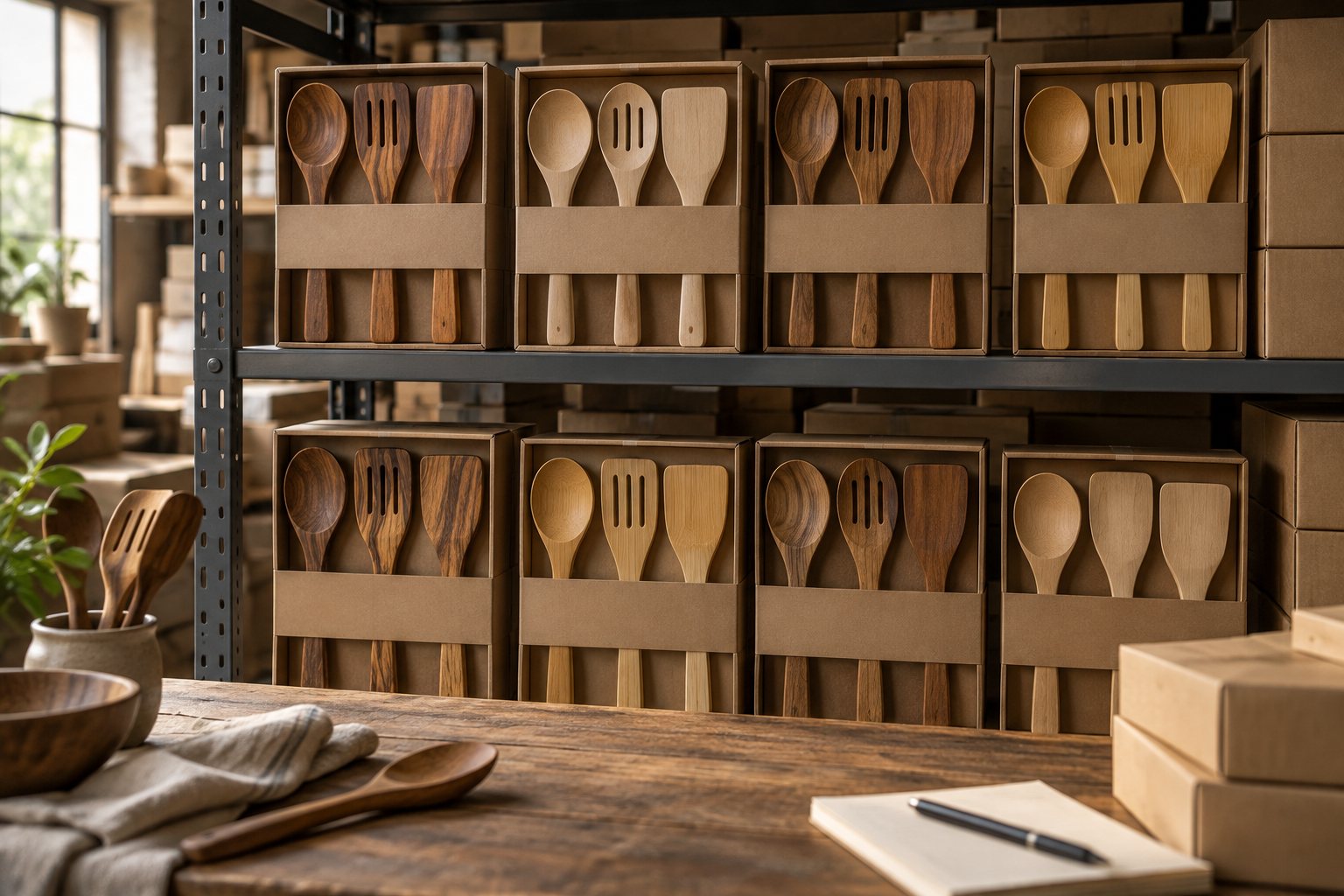
A wholesale assortment earns its shelf by offering a deliberate ladder rather than a pile of similar goods. The common structure runs on three tiers. A value tier in beech or rubberwood, pale, consistent, easy to explain, protects the entry price point. A mid tier in acacia, dense and water-resistant with bold striped grain, carries the visual character that sells on sight. A premium tier in teak, or walnut and olive wood for specific stories, anchors the brand's ceiling and lifts the perceived quality of everything beside it. Programs that skip a tier leave the customer a gap to walk across; programs that double up within a tier create internal competition on price. Species characteristics are documented in the wood library, with deeper notes for teak and beech.
Packaging for retail shelves
Wholesale packaging has to work in two places at once: on the shelf and in the carton. On the shelf, the piece needs to sell itself without a salesperson, which argues for printed sleeves that show the grain, hang tags that carry the care story and the species name, and open boxes for premium sets. In the carton, every retail unit needs protection that survives wholesale distribution, which is a different drop profile than a single parcel. The two layers are specified together, retail unit plus master carton, and carton drop handling is one of the standard quality checks before shipment. Branding elements and box options are laid out on the private label page.
Reorders are the real business
The first order proves the program; the reorders pay for it. A stock program reorders well because the masters exist, the golden sample is on file, and the engraving artwork is already approved, so a repeat order skips the expensive steps and the calendar tightens accordingly. Reorder quantities and lead times are confirmed in writing, and buyers running seasonal peaks, the gifting season above all, place reorders with the full calendar in view rather than at the moment shelves empty. Assortment discipline matters at reorder too: replacing what sold and resisting the urge to refresh every SKU at once keeps the shelf readable for returning customers. Reorder mechanics are expanded in the reorder planning note and the price-side view in wholesale-to-retail pricing.
Planning depth without overreaching
Wholesale depth, how many units of each style sit in a reorder, is planned from turn rates, not from container enthusiasm. The working method is to size the first order to the smallest quantity that reaches the reference MOQ on every style, then let sell-through data, not forecasts alone, set the reorder profile. Two habits protect new programs: holding one style slightly deeper than the rest as the traffic anchor, and resisting species proliferation until a tier proves itself, because each added species multiplies carton variants and minimums across the whole range. Depth planning is also where stock programs quietly beat custom ones, since repeat orders on existing masters skip proof rounds and reuse the golden sample already on file, tightening both the calendar and the cash cycle.
What to send the desk
- Your channel and retail position, which selects the tier structure.
- Shapes of interest, or the role the line plays in your assortment.
- Species preferences, or tone and price targets if species is open.
- Packaging ambitions: sleeves, hang tags, boxes, carton marks.
- Quantity ranges per style and a first in-warehouse date.
Wholesale programs are quoted per program, never from a fixed list, because species, shapes, finishes and packaging all move the answer. Send your channel brief and the desk will return a tiered assortment proposal with written terms in one reply.