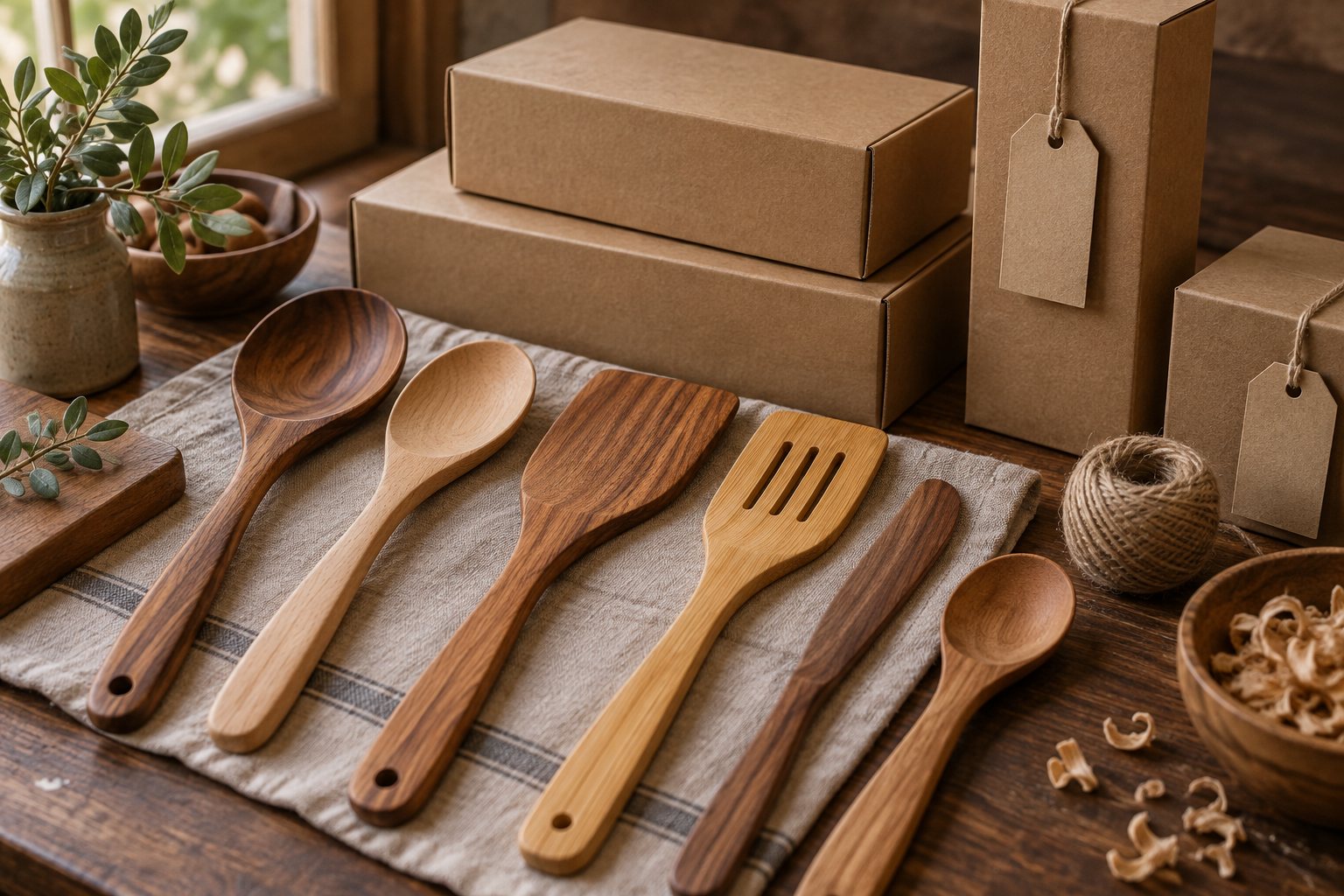
What private label means on a wooden tool
Private label wooden utensils are stock or custom shapes carrying your brand instead of ours, on the piece, on the packaging, or both. The good news is that wood accepts a brand unusually well: a mark can be burned into the surface so it becomes part of the material, rather than sitting on top of it as ink does on plastic. The discipline is in the details, artwork format, proof approval, and the separate minimums that packaging suppliers set. This page walks through each element in the order your program will meet them.
Three branding methods
| Method | How the mark reads | Considerations |
|---|---|---|
| Laser engraving | A burned mark in the wood's own tone, precise lines and small type hold well | The common method; durable and natural-looking; depth and size fixed on the artwork proof |
| Heat branding | A deeper, darker burned mark with a rustic, handmade character | Suits artisanal lines; less fine detail than laser |
| Silkscreen print | Ink on the surface, in a chosen color | Only method that carries a color logo; sits on the surface, so wear behavior should be discussed for washing surfaces |
Laser engraving is the default for good reason: it burns a durable, natural-looking mark into the surface with no inks or pads, it holds fine lines and small type, and it ages the way the wood ages. Heat branding produces a bolder, darker mark that suits gift and artisanal positioning. Silkscreen print is the choice when brand colors matter more than tactility. Some programs combine methods, an engraved handle with a printed sleeve, for example, and each element gets its own proof.
The artwork proof
Every mark starts as artwork, and the single biggest time-saver in a private label program is sending usable artwork first: a vector file with the logo as clean, one-color line work. Photographs, gradients and very fine serifs lose detail when burned into wood, so marks designed for print usually need simplifying for engraving. The desk reviews the artwork for suitability, proposes mark size and position, and the workshop produces a proof piece. You approve the physical proof, or request changes, and the approved proof defines engraving depth, size and position for the whole run. Only then does bulk start, and the inspection stage checks production against that proof rather than against opinions. The proof round is part of the flow described on our quality control page, and the artwork stage in detail is in our note on laser engraving wooden utensils.
Packaging that suits the material
Packaging is where private label programs earn their shelf presence, and wooden goods have one quirk to respect: finished wood should not be sealed airtight while any moisture remains, so packaging is designed to protect while letting the material breathe. The common elements:
- Boxes. Gift boxes, kraft or printed, open or with a window, sized to the set.
- Printed sleeves. A board printed with your branding that slides over a banded set; the economical shelf option.
- Hang tags. Debossed or printed tags wired or tied to a handle.
- Care cards. A card with washing and re-oiling guidance, written to match the finish system on your spec; the desk supplies adaptable copy through the care hub.
- Carton marks. Shipping cartons printed with your marks and handling symbols to the packing spec.
Unboxing is part of the product experience, and it is worth deciding early whether your program is a shrink-wrap value line or a boxed gift line, because that choice drives packaging cost, carton size and freight volume at the same time. Our note on packing wooden utensils covers the journey from sleeve to sealed carton.
What carries supplier minimums
The minimums in a private label program are not all the same kind. Laser engraving is usually flexible on stock designs, because the setup is quick and the cost sits per piece; new artwork still needs its proof round, and new artwork setup is confirmed per program. Custom packaging is different: boxes, printed sleeves and hang tags are produced by packaging suppliers who set their own minimums per design, separate from the utensil MOQ. Carton marks are usually modest but are also confirmed rather than assumed. The desk itemizes which element carries which minimum when a program is quoted, so you can trade elements against each other, for example an engraved mark on a stock design with a simple sleeve, before committing. Reference ranges for the utensil side, typically from about 500 pcs per style for stock shapes, are set out on the MOQ and lead time page, and each program's figures are confirmed in writing.
The private label flow
- Brief. Shapes, species, quantity range and branding intent, including whether packaging is in scope.
- Artwork review. The desk checks the logo for engraving suitability and proposes mark size and position.
- Proof piece. The workshop engraves a sample; you approve depth, tone and position physically.
- Golden sample. The approved piece, with its mark, becomes the standard the run is judged against.
- Bulk production. Carving, sanding, finishing and engraving proceed; packaging is produced in parallel once its own proof is approved.
- Inspection and packing. Marks are checked against the proof, then pieces are packed to spec with care cards and carton marks applied.
Where private label fits
Kitchenware brands use engraving to lift a stock set into a branded line without custom tooling. Cookshops engrave a house mark on beech basics and reorder the same approved program for years. Corporate and promotional buyers put a logo on a gift-boxed set for a launch or a thank-you program, where the box and the care card do as much work as the mark. Worked examples of all three shapes of program are on the program cases page, and the corporate version in particular is expanded on our corporate wooden gifts page. For the full journey from artwork to cartons, our guide to private label wooden utensils goes deeper. When you have artwork ready, or want a view on what it can become, send it with a brief and the desk will reply with suitability notes and a proof plan.