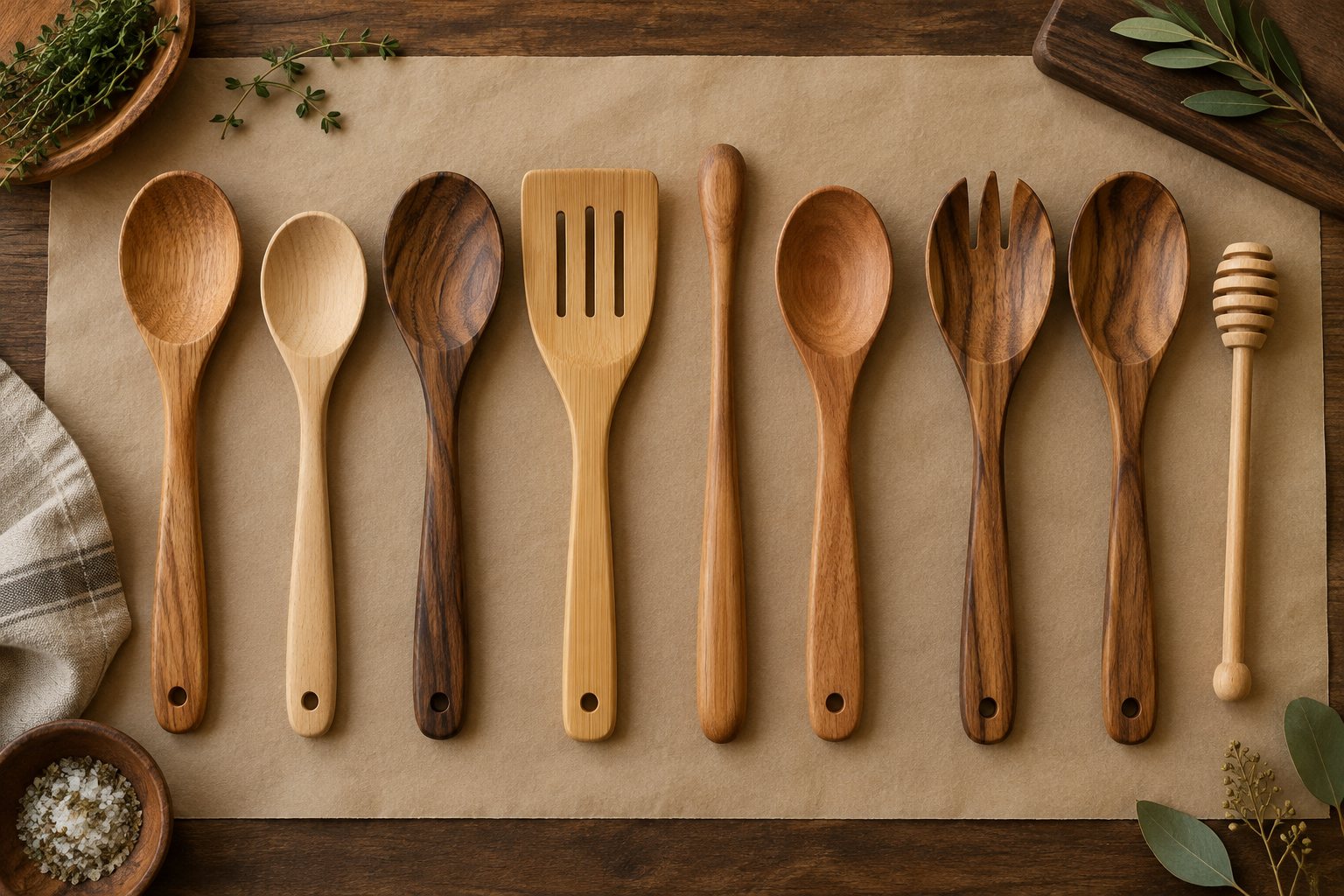
Shape choice is the first sourcing decision
Most buyers arrive at a wooden kitchen utensil program with a shape list that is either too short or borrowed whole from another catalog. Both create trouble. A list that is too short leaves the set without rhythm on the shelf, and a borrowed list competes on price alone against identical goods. The shape list is where a program earns its position, because shapes decide how the pieces photograph together, how they pack into a carton, and how much custom carving the workshop has to absorb before the first sellable piece exists.
This page is the map for wooden cooking utensils. It lists the shapes the category draws on, the woods that suit each, and the role each piece plays in a range. The linked guides go deeper on the shapes that carry most programs, so you can read the overview here and the detail where your assortment needs it.
The shape ledger
| Shape | Typical woods | Role in a program | Guide |
|---|---|---|---|
| Solid spoon | Beech, teak, acacia | Anchor piece of most sets | Spoons |
| Slotted spoon | Beech, teak | Draining, lifting and tasting work | Spoons |
| Corner spoon (jar spoon) | Beech, olive wood | Specialty add-on for jars and pan corners | See spoons guide |
| Spatula / turner | Beech, teak, oak | Flat pan work and scraping | Spatulas |
| Spatula-scraper | Beech | Jar, bowl and pan-edge work | See spatulas guide |
| Spurtle | Teak, beech | Stirring thick dishes; story piece | Spurtles |
| Salad servers (pair) | Acacia, olive wood, teak | Gift and table positioning | Salad servers |
| Fork | Beech, acacia | Balances a set beside the spoon | See spoons guide |
| Pasta server | Beech, teak | Niche add-on for pasta-focused lines | See sets guide |
| Tongs | Bamboo, teak | Serving and light pan work | See sets guide |
| Ladle | Teak, beech | Soups, stews and deep pots | See sets guide |
| Honey dipper | Beech, olive wood | Small-tool basket filler with gifting pull | See sets guide |
| Butter spreader | Beech, oak | Small-tool add-on for table lines | See sets guide |
| Spoon rest | Teak, acacia | Counter companion that lifts the set story | See holders guide |
| Utensil holder / crock | Teak, acacia, bamboo | Completes the set on the counter | Holders |
| Salt cellar / pinch bowl | Acacia, oak | Table and counter pieces for extension lines | See holders guide |
| Cutting and serving boards | Teak, acacia, walnut | Adjacent category for range extensions | See the wood library |
| Rolling pin | Beech, oak, rubberwood | Baking extension for established lines | See sets guide |
Two conventions run across the whole table. Lengths for cooking tools commonly run roughly 10-13 in as common options, confirmed on the spec sheet for each piece. And set sizes are commonly 3-7 pieces, while published ranges include 4-, 5-, 12- and 14-piece sets, so a program can start small and widen later without changing suppliers or finishes.
How buyers group the shapes
Cooking tools
Spoons, spatulas, spurtles and ladles do the hot work, so they carry the heaviest requirements: sound grain, a finish system that holds up to oiling, and handles that stay comfortable over a hot pot. These are the pieces a buyer tests first, because they are used daily and judged hard. A set lives or dies on whether its cooking tools feel right in the hand, which is why we recommend physical samples of every cooking shape before a program is fixed.
Serving and table pieces
Salad servers, forks, pasta servers and small tools such as honey dippers and butter spreaders appear at the table, so tone and grain matter more than for tools hidden in a drawer. These pieces also gift well, which changes the packaging conversation: a pair of acacia salad servers in a printed sleeve is a different product from the same pair loose in a bin. Buyers who split their range into cooking and table groups usually find the table group supports higher retail prices.
Counter and storage pieces
Utensil holders, spoon rests and salt cellars live on the counter, next to the range rather than in it. They are heavy, they absorb the moisture of freshly washed tools, and they turn a loose set into a merchandised display. A holder also changes the search behavior around a program: many retail buyers want a wooden utensil set with holder as a single unit, and the holder is the piece that makes that listing possible.
Shape follows species, or species follows shape
In practice the two decisions are made together. Olive wood blanks are smaller, so dramatic swirl grain shows up best in spoons, spreaders and salad servers rather than long tools. Beech machines cleanly at almost any length, which is why it anchors value cooking lines. Teak takes almost any shape and rewards it with warm brown tone and dark grain, which is why teak programs read as premium across the whole shape list. Our wood library covers the species in detail, and the sets guide shows how shapes combine into a coherent range.
What to send the desk
- The shapes you want, marked as stock or open to custom carving.
- A species direction, or the tone and retail position you are aiming at.
- Set sizes if the program ships as sets, and whether a holder is included.
- Branding intent, so engraving and packaging can be planned with the shapes.
- A quantity range per style, even a rough one.
With that, the desk can reply with a route, a species recommendation and a sampling plan in one written reply. Send a brief when the shape list is ready, even if it is only three shapes long.