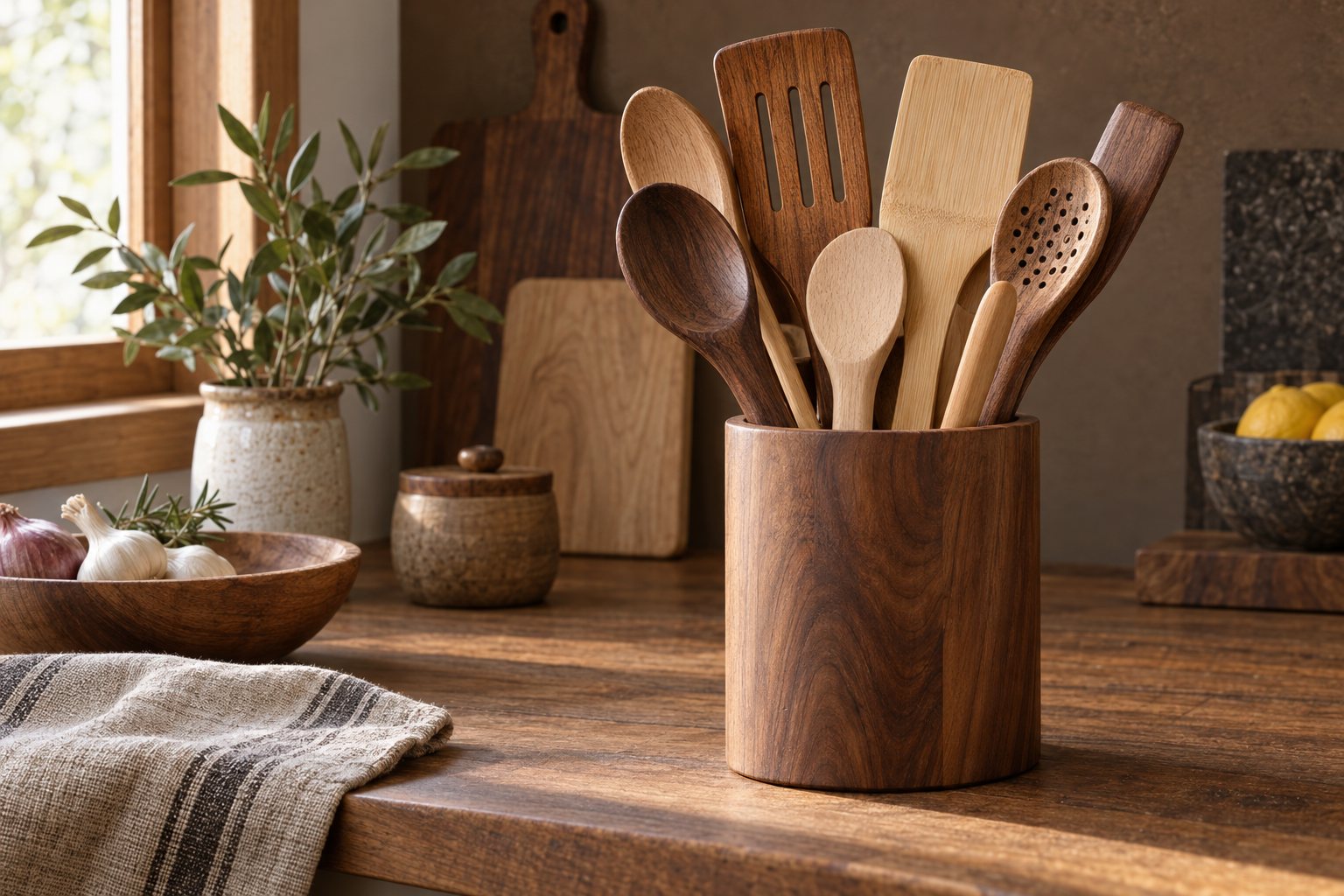
The piece that lives on the counter
Every other piece in a wooden utensil program is picked up and put away. The holder stays out, holds the set upright at the point of use, and advertises the program at every hour of the day. That visibility is why retail buyers keep asking for a wooden utensil set with holder as a single listing, and why the holder often decides whether a set looks complete or spare on a kitchen counter. It is also, quietly, the most demanding piece in the range from an engineering standpoint: it carries the weight of every tool, it must not tip when the set is pulled out one-handed, and it receives tools that are still damp from washing.
What a holder has to survive
Three forces dominate the spec. Weight: a crock with seven tools inside is heavier than it looks, and the base and walls must carry it without checking at the joints, which argues for dense species and sound glue-line work in any laminated construction. Stability: a tall, narrow crock tips when a long spoon is levered sideways, so the footprint and the base weight are set against the tallest tool in the set. Moisture: tools go back in the crock damp, and the interior must tolerate that cycle without holding water against the wood. Programs that specify for the third force honestly are the ones whose holders still look right a year later.
Drainage and airflow, stated plainly
Wood prefers to be dry, and a closed-bottom crock that traps a puddle inside will eventually show it. The design answers are conventional and effective: an interior that drains toward one point, a base detail that lifts standing water away from the wood, ventilation that lets air move around the tool handles, and care instructions that ask the user to dry tools before returning them where practical. Buyers should also ask which adhesive system a laminated bamboo or panel-wood holder uses and what documentation carries it, because moisture resistance starts with the glue line. The care side of this conversation, drying, re-oiling, and where to site a holder on the counter, is covered in the care hub and the storage note.
| Attribute | Options to decide | Notes for the spec sheet |
|---|---|---|
| Format | Single-compartment crock; wide-mouth holder; divided interior | Divided interiors sort tools but clean harder; confirm interior access |
| Size | Sized to the tallest and fullest tool set it will hold | Confirm against the actual set, not a generic tool count |
| Base | Solid base with drainage detail; raised interior floor | Standing water against wood is the failure mode to design out |
| Species | Teak, acacia, bamboo, oak, rubberwood | Dense, water-resistant species suit the wet duty cycle |
| Finish | Food-contact oils; film finishes generally avoided on wood kept near food | Confirm the finish system and its documentation in writing |
| Stability | Footprint and base weight set against the tallest tool | Tip test belongs in sampling, one-handed pull |
Paired-set merchandising
The strongest retail argument for the holder is the bundle. A five or seven piece set that ships with its own crock photographs as a finished product, justifies a higher single-SKU price, and removes the buyer's where-will-I-put-it objection at the point of sale. The logistics argument runs the other way: a crock adds cube and weight to every carton, which shows up in shipping economics on every unit. Many programs resolve this by offering the set both ways, with the holder as an add-on SKU for parcel channels and bundled for gift and hospitality channels, and both listings share the same photography so the assortment reads as one family. The set-building logic sits on the sets page.
Species and weight
Teak and acacia bring the dense, water-resistant character the duty cycle rewards, with warm tones that carry a premium position. Bamboo offers a hard, light, striped look at an economical position, with the adhesive question raised above asked and answered in writing. Oak reads solid and rustic and takes the weight argument in its stride, and rubberwood serves value programs where the holder is a set filler rather than a hero piece. Whatever the species, the piece is finished with food-contact oils that the user can renew, because a holder that cannot be re-oiled cannot be maintained by its owner.
Where the holder sits in a kitchen line
Within a brand's assortment, the holder plays the completeness role: it is rarely the first purchase, and it is often the reason a first purchase turns into a family. Holders tend to sell beside sets rather than alone, which is why we plan the crock, the set and the photography as one brief instead of three. Formats and drainage choices are set out further in the holders and crocks note, and the counter-placement advice that keeps wood dry enough to live long is in the storage note. For hospitality projects, holders do a third job, tidying service stations, where a divided interior earns its extra cleaning time and a heavier base earns its keep against daily traffic.
What to send the desk
- The tool set the holder must carry, tallest and fullest pieces named.
- Format: crock, wide-mouth holder or divided interior.
- Species direction, and whether the piece bundles or sells separately.
- Counter context: parcel channel, retail shelf or hospitality project.
- Quantity per style and branding intent.
Bring the set, not just the crock, and the sizing decisions make themselves. Send a brief and the desk will propose formats and species with a sampling plan in one written reply.