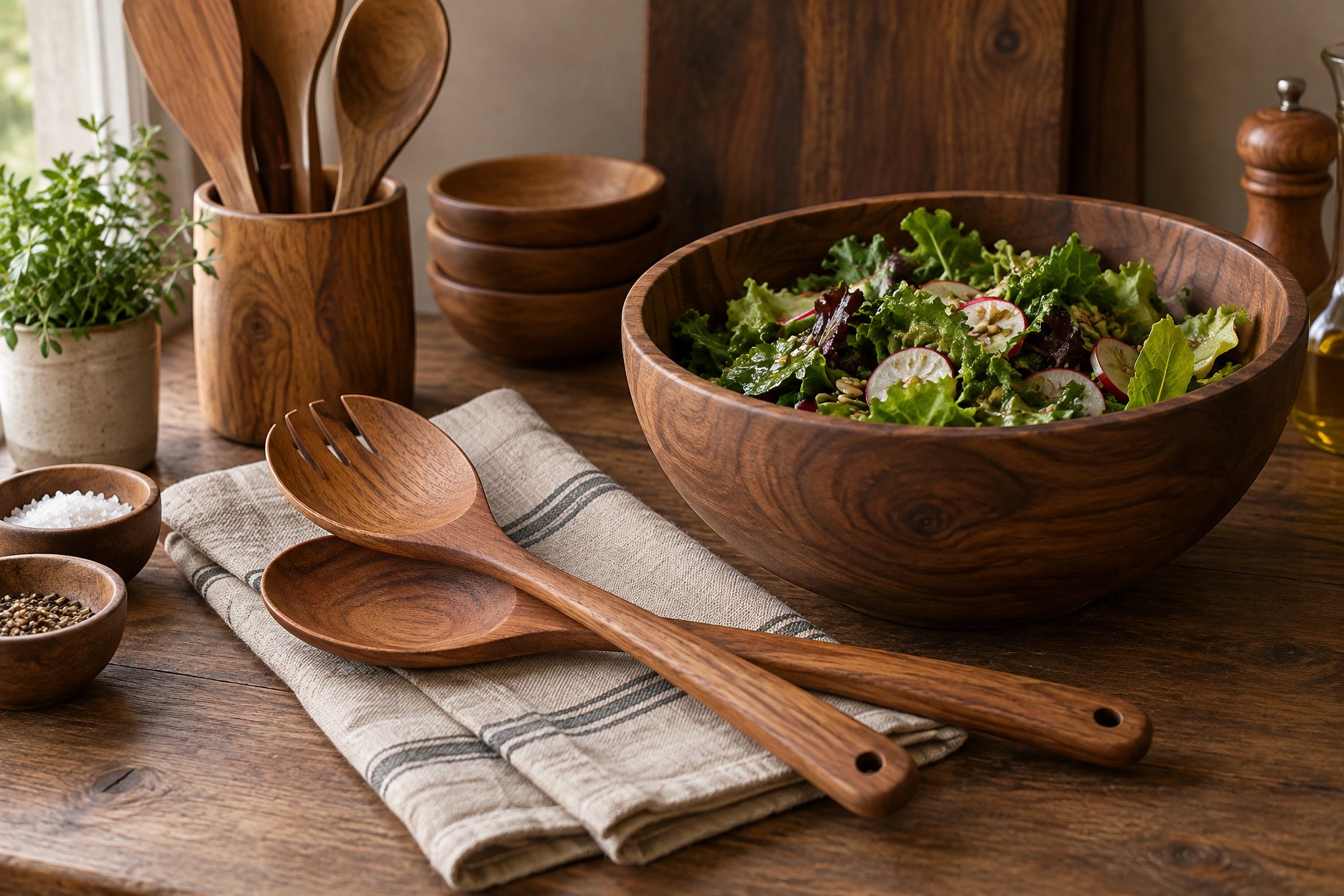
Pairs sell differently than single tools
A cooking spoon is bought as a replacement or as a set member. Wooden salad servers are bought as a pair, as a table decision, and very often as a gift. That difference rewrites the brief: the two pieces must match in tone and weight, the pair must present well without a box if the channel is a market stall or a shelf bin, and the retail story is about the table, hospitality and giving rather than about cooking performance. Buyers who treat salad servers as small cooking tools misprice them and mispackage them; buyers who treat them as table goods with a gift life price them confidently.
Anatomy of a pair
A traditional pair is one fork hand and one spoon hand. The spoon hand lifts leaves and dressings; the fork hand anchors and portions. Some programs offer two spoon hands for buyers who prefer a symmetrical look, and both formats are legitimate; the fork-and-spoon pair is the convention and the safer default for retail. What matters for the workshop is that the two pieces are finished and weighted as a set, because a pair where one piece feels lighter than the other reads as a mismatch on a set table, and mismatched pairs are the most common reason salad servers are returned as gifts.
| Attribute | Common options | What buyers decide |
|---|---|---|
| Piece pairing | Fork hand plus spoon hand, or two spoon hands | Convention versus symmetry, per channel |
| Length | Common options, confirmed on the spec sheet | Salad bowl depth and serving reach at the table |
| Handedness | Fork hand shaped for a right-handed default | Whether to offer a left-handed option or ambidextrous shaping |
| Species | Acacia, olive wood, teak, walnut | Tone, grain story and gift price position |
| Packaging | Band, printed sleeve, two-piece box, hang tag | Shelf bin versus gift shelf presentation |
| Branding | Laser engraving on the handle end, debossed hang tag | Retail brand versus corporate gift personalization |
Handedness, an honest spec line
A fork hand with curved tines works most naturally in one hand. Workshops shape the default for right-handed use because that matches the market majority, but a left-handed option or a gentler ambidextrous curve is a real specification choice, not an afterthought. Programs that state their handedness on the product page, and mean it, collect noticeably better reviews in gift channels, where the pair is sometimes bought for a specific recipient. If you offer only the default, say so plainly rather than leaving it for the buyer to discover.
Length and the bowl
Serving reach is the function that length serves. Salad bowls run deeper than dinner plates, so the pair must reach the bottom without burying the handles in the leaves. Lengths are common options confirmed on the spec sheet rather than a category standard, and the practical test is the same filled-bowl test used for spoons: the pair should serve from the base of the bowl while the handle ends stay clean and clear of the rim. Shorter pairs suit individual salad bowls and side service; longer pairs suit the family table and buffet service, and many programs carry one of each length as two SKUs.
Species with table presence
Acacia is the natural leader for salad servers: dense, water-resistant, with high-contrast striped grain that no two pieces share, which gift buyers read as character. Olive wood brings dramatic swirl grain and aroma in smaller blanks, ideal for premium single pairs. Teak offers warm brown tone and durability at a premium price position, and walnut reads formal and dark for tailored table lines. Because these pieces appear on a set table, tone matching within the pair is checked against the approved golden sample; grain and shade variation is natural in solid wood and is defined as acceptable range, not defect. Species backgrounds sit in the acacia and teak guides.
Gift positioning and branding
Pairs are the category's most natural engraving canvas: a short name or date on each handle end turns a table piece into a wedding, hostess or corporate gift. Laser engraving is the common branding method, usually flexible on stock designs with new artwork setup confirmed per program, and placement is settled on the artwork proof. Corporate programs often build around salad pairs plus a set of cooking tools in the same species, and the corporate gifts page shows how that brief is assembled. For retail, a printed sleeve that shows the grain through a window sells the pair without unboxing it.
The two-length strategy
Programs with room for two SKUs usually carry a longer table pair and a shorter side-service pair in the same species, which reads as one product line and serves two different bowls. The strategy has a quiet operational benefit too: the shorter pair can often be cut from blank offcuts of the longer one, which improves yield on premium species and softens the unit cost of the pair at the top of the range. Where the two lengths differ is in presentation, not function, so packaging and photography should treat them as one family with two sizes rather than as separate products. Design and pairing background sits in the salad servers design guide.
What to send the desk
- Pair format: fork and spoon, or two spoons, and any handedness requirement.
- Species and price position, with the channel it will sell in.
- Length as a common option range, and the bowl depth it must serve.
- Packaging: band, sleeve or gift box.
- Quantity per style and engraving intent.
The pair is a small program that carries a brand's table story, so it is worth sampling well. Send a brief and the desk will propose species and packaging routes in one written reply.