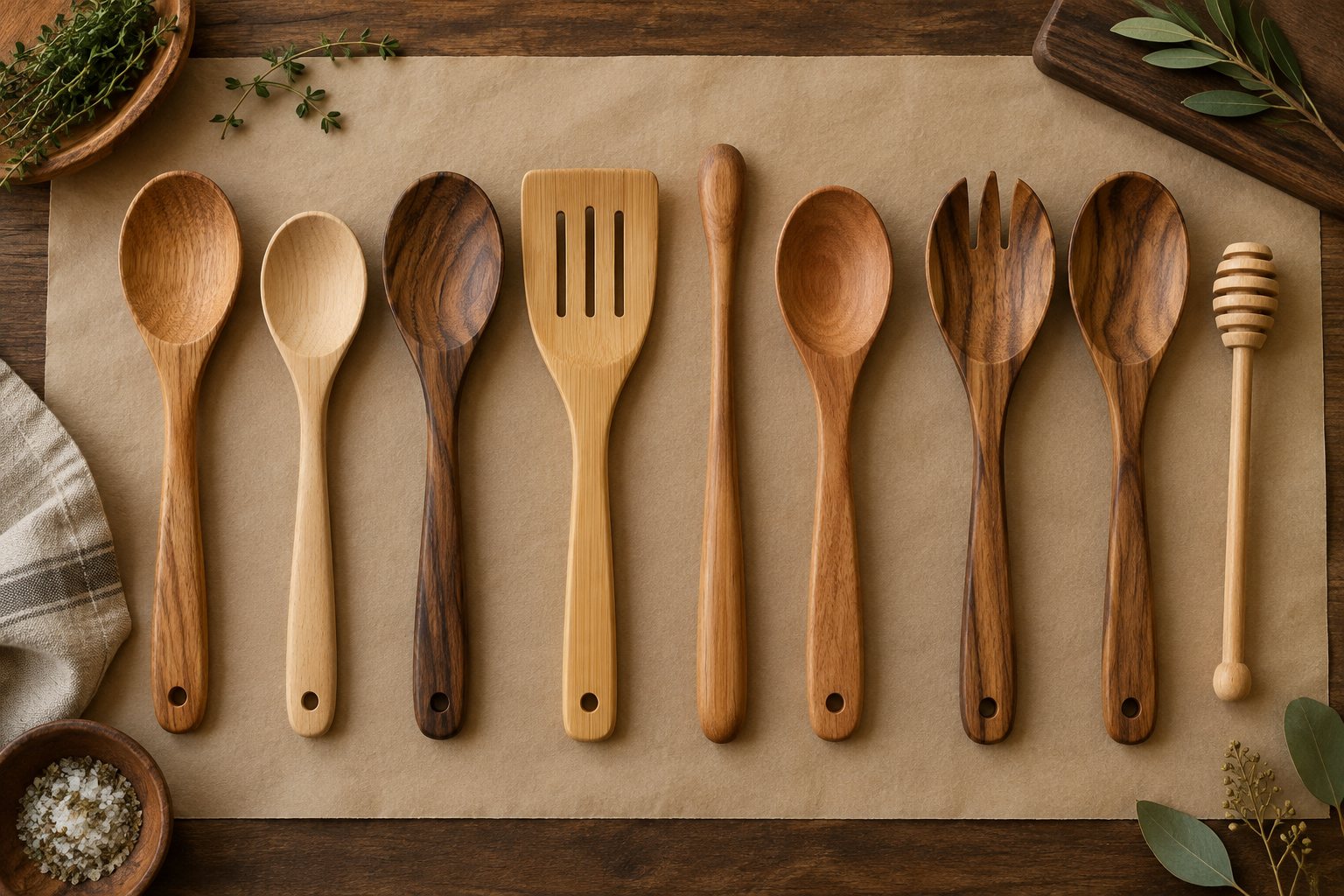
Two materials, two buying reasons
A shopper picks up a wooden spoon because of how it feels and what it says about the kitchen: natural material, visible grain, quiet craft. A shopper picks a silicone tool for different reasons: it survives heat and the dishwasher without a thought, it comes in colors that match a kitchen, and it flexes into shapes wood cannot hold. Neither story is stronger; they answer different questions. Programs fail when they treat the two as substitutes instead of neighbors.
Side by side for program planning
| Aspect | Wooden utensils | Silicone utensils |
|---|---|---|
| Feel and look | Warm, grain visible, no two identical | Smooth, uniform, color-driven |
| Heat at the pan | Low conduction; handles stay comfortable; never leave in the pot | High heat tolerance; can rest in the pot |
| Care | Hand wash, dry, re-oil occasionally | Dishwasher friendly, no upkeep |
| Edge behavior on pans | Gentle on nonstick coatings | Gentle when quality silicone; stiff cores can scratch if exposed |
| Branding | Laser engraving, a permanent and natural-looking mark | Molded-in marks or printing |
| Story on the package | Material, species, origin of the grain | Function, color system, convenience |
| Aging | Develops character; can be sanded and re-oiled | Discolors and wears invisibly over time |
Where wood wins the comparison
Wood's advantage is the story and the object. A walnut spoon is a small piece of material with a visible history, and laser engraving sinks a logo into it permanently. Gift buyers, cookshops and premium kitchen brands buy that story, and care guidance becomes part of the relationship rather than a defect: oiling a spoon is a small ritual many customers enjoy. Wood also stays comfortable in a hot pot handle-side, because it conducts little heat, and its edges are kind to nonstick coatings.
The cost of that story is upkeep. Wood cannot go in the dishwasher, and a brand that hides this fact gets one-star reviews. Our care hub exists because honest care guidance, printed on a card and repeated on the product page, converts upkeep into trust.
Where silicone wins
Silicone answers the zero-effort kitchen. It goes into the dishwasher, tolerates resting in hot pans, and bends into scrapers and whisks that wood cannot imitate. Color programs and seasonal refreshes are trivial in molded silicone. For a brand whose customer values convenience above story, silicone is the honest recommendation, and recommending it when true is part of the desk's job.
Silicone's weaknesses are the mirror of its strengths: uniformity means no material story, quality varies widely between grades, and cheap tools can develop permanent discoloration and odor that customers only discover after weeks of use.
Program patterns that use both
- Tiered shelf. A wood line at the top of the price range, silicone for the everyday tier, so the retailer captures both motivations without cannibalizing either.
- Gift set with a silicone insert. A wooden set boxed with a silicone mat or trivet adds function without diluting the material story.
- Care-card upsell. Silicone buyers who receive a wood gift often ask how to maintain it; a care card turns a one-time gift into a repeat customer for the wood line.
How the sourcing differs
Wood programs are carved from species with natural variation, judged against a golden sample, and branded by engraving; stock designs typically start from about 500 pieces per style, and fully custom shapes typically from about 1,000, confirmed in writing for each program. Silicone programs are molded: tooling cost dominates the first order, colors are free after the tool exists, and the MOQ conversation is about tool amortization instead of carving. The two calendars also differ: wood moves through sampling in days and production in weeks; silicone waits on tooling first. The desk coordinates both routes and quotes each on its own terms. See MOQ and lead time for the wood side.
Questions buyers ask when weighing the two
Which material photographs better?
Wood photographs with depth: grain, tone and hand-carved edges give every angle something to look at, and lifestyle shots of a worn, oiled spoon communicate quality without a word of copy. Silicone photographs clean and bright, which suits color-forward listings, but every unit looks the same, so the image has to sell function instead of material. Brands with a strong color system often lead with silicone sets and let wood carry the premium end.
Which material produces fewer returns?
For different reasons, both return profiles depend on expectation setting. Silicone returns usually trace to quality disappointment, a tool that stains or holds odor, which sourcing discipline prevents better than copy can. Wood returns trace to care surprises: a spoon that went through the dishwasher or was left soaking. That makes the care card the most cost-effective return-prevention tool in the program. Brands that ship wood with a visible care card and repeat the hand-wash rule on the listing page report fewer disappointed reviews even when the occasional spoon still cracks.
Does wood cost more to ship?
Wooden tools are rigid and light, so they pack efficiently in nested sets and rarely need the bubble wrap that delicate goods demand. The real packing decisions are presentation ones: sleeves, boxes and carton marks that carry the brand. Silicone is similarly light but often ships loose or bagged. Neither material is a freight problem; both are packed to the program spec and confirmed in writing. Our note on packing and cartons covers the details.
A decision path in four questions
- Who is the customer? Gift, cookshop and premium buyers lean wood; convenience-driven everyday buyers lean silicone.
- What does the shelf already say? If your brand voice is material and craft, wood extends it. If it is color and function, silicone extends it.
- What service promise can you keep? Only promise dishwasher-friendliness if the product is silicone; only promise heirloom longevity if you ship care guidance with wood.
- What is the reorder rhythm? Wood reorders ride on stock carving patterns; silicone reorders ride on existing tools. Both favor steady programs over constant novelty.
Answer those four and the material choice usually makes itself. When it does not, the desk quotes both routes side by side so the comparison is written, not guessed.
What to send the desk
Tell us which customer you are serving and what the shelf already carries. A reference photo of a set you like, your price position, and a quantity range are enough for a written first reply naming the route, the species or the reason to consider silicone, and the sampling plan. Start a quote, or compare species first in the wood library.