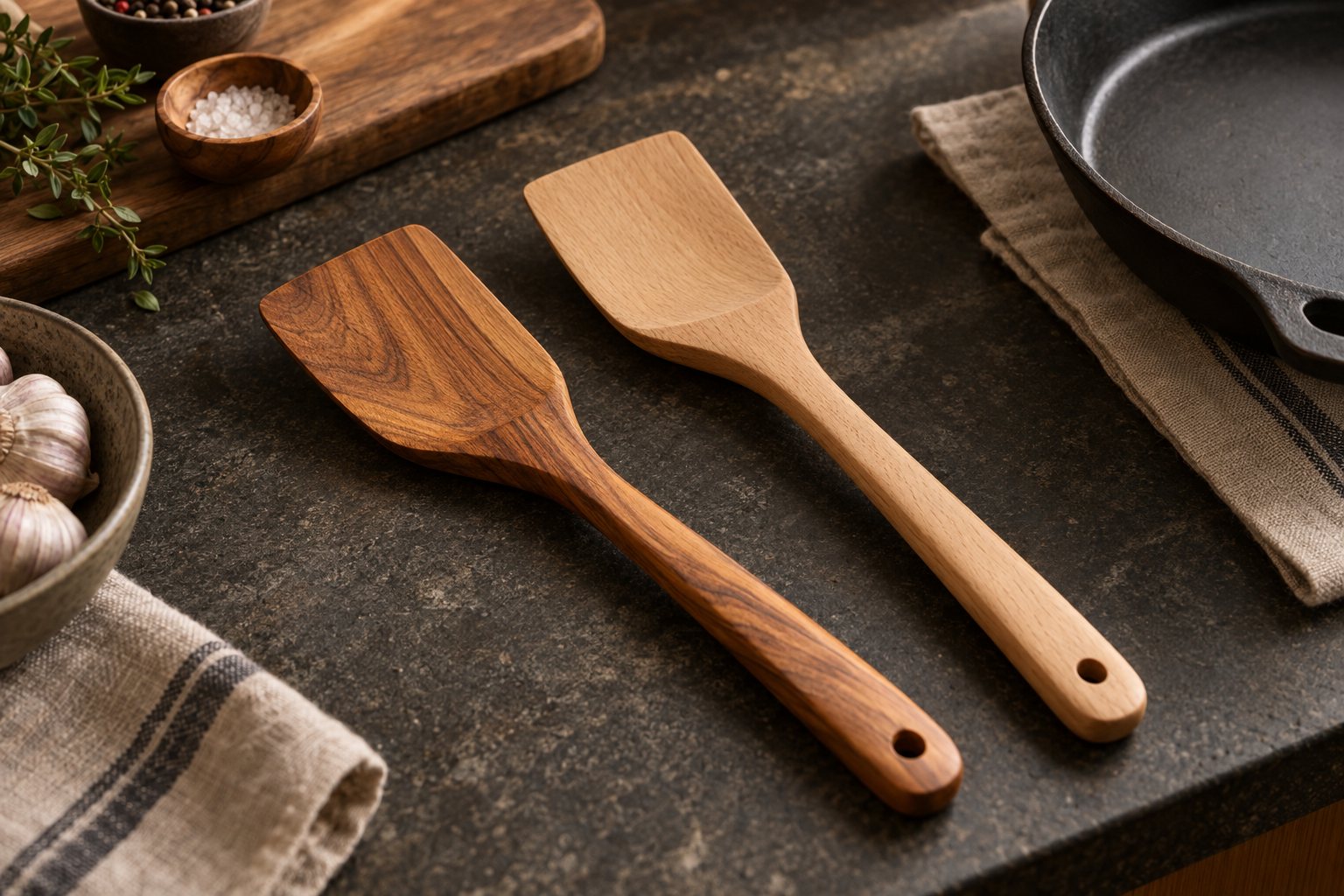
Flat tools do different work than spoons
Spoons stir and carry; spatulas scrape, fold, flip and level. That difference in job produces a different geometry: a wide, flat blade, a thin working edge, and a handle aligned with the blade rather than rising out of a bowl. Buyers who specify a spatula as if it were a flat spoon end up with a tool that cannot get under a fried egg or into the corner of a saucepan, and the piece fails in use no matter how handsome the grain looks. This page sets out the geometry decisions that make a wooden spatula or wooden turner actually work, and the species that suit the job.
The family and its variants
| Variant | Geometry notes | Best use | Typical woods |
|---|---|---|---|
| Classic spatula | Rounded rectangular blade, thin edge, straight handle | Scrambling, sauce work, sauteing, scraping | Beech, teak |
| Turner | Wider, flatter blade with a shallow forward angle for lifting | Getting under pancakes, fish and vegetables | Teak, acacia, oak |
| Spatula-scraper | Narrow, flexible-feeling blade shaped for jars and bowls | Mayonnaise jars, batter bowls, pan edges | Beech |
| Angled corner tool | Blade set at an angle so the edge meets pan walls flat | Corner work in saute pans and roasting trays | Beech, teak |
The variants share one principle: the working edge meets the pan, not the food alone. That is why edge geometry dominates the specification conversation, and why a photograph of a spatula tells you less about its quality than holding it against a flat surface and checking that the edge sits down evenly along its length.
Edge thinness and its honest limits
A thin edge slides under food and scrapes cleanly; a thick edge pushes food around. But thinner is not infinitely better, because the edge still has to survive years of pan contact and the occasional bang against a pan rim. Workshops resolve this with a thin working edge that tapers from a stronger spine, with corners rounded so the tool cannot catch or splinter. The taper is felt, not measured by buyers, which is another reason physical samples matter here more than for round tools. Final grit of sanding and edge treatment are confirmed per spec, and we check edges for smoothness and splinter-free finishing as part of the quality checks before packing.
One caution belongs on every spec sheet: a wooden edge is a working edge, not a knife blade. Programs that promise knife-like function set up disappointment; programs that promise clean pan contact and gentle scraping earn repeat orders.
Why wood suits nonstick and coated pans
Wood is gentle on nonstick coatings versus metal tools, which is the practical reason cooks keep a wooden spatula by the stove even in all-metal kitchens. The edge cannot gouge a coating the way a metal lip can, and wood conducts heat slowly, so the handle stays comfortable where a metal handle would need an insulator. Two care rules keep that promise honest: avoid leaving the tool in a hot pot unattended, and hand wash and dry promptly rather than dishwashing, because heat and detergent strip oil and can crack wood. Both rules belong in the packaging copy, and our care hub covers the full routine.
Species picks for flat tools
Beech again anchors the value end: it holds a fine edge, machines cleanly and keeps a consistent pale tone across a run. Teak suits premium flat tools because its density and natural oiliness resist water uptake around the thinnest part of the tool, which is exactly where wear shows first. Oak gives a pronounced open grain and heft that reads rustic and strong, with sealing awareness written into the program spec. Acacia adds striped character for gift-positioned pieces. There is more on how flat tools compare with silicone in the wood versus silicone comparison.
Program notes
Lengths commonly run roughly 10-13 in for cooking tools as common options, confirmed on the spec sheet. In sets, the spatula usually pairs with a solid spoon and a slotted spoon, and the scraper variant is the easiest way to add a fourth piece that buyers perceive as useful rather than as filler. Engraving sits on the handle, well back from the working edge, with placement and size settled on the artwork proof.
Edges and finishing, checked by hand
Because the spatula is defined by its edge, the finishing checks concentrate there. Corners are rounded so nothing catches on a pan coating or a fingertip; the working edge is sanded through the same grit sequence as the rest of the tool, with special attention where the taper thins; and the final touch standard is agreed against the golden sample rather than described in words. Design notes for flat tools, blade width, forward angle and handle transition, are set out in the spatula and turner design note, and the finishing stages are shown in the edge finishing note. Buyers who arrive at sampling with a piece of white paper, laying the blade down to check for rocking and gaps, tend to catch geometry issues in minutes that a spec sheet would hide for weeks. It is a low-technology check that works.
What to send the desk
- The variants you want and their jobs: scrambling, lifting, scraping or corner work.
- Species direction and retail position.
- Length range within the common options, and blade width preference.
- Whether the piece joins an existing set, so tone and finish match.
- Quantity per style and branding intent.
Flat tools reward a short sampling round because geometry is felt immediately. Send a brief and the desk will propose stock blades to test in hand before any custom edge work is quoted.