How to read these cases
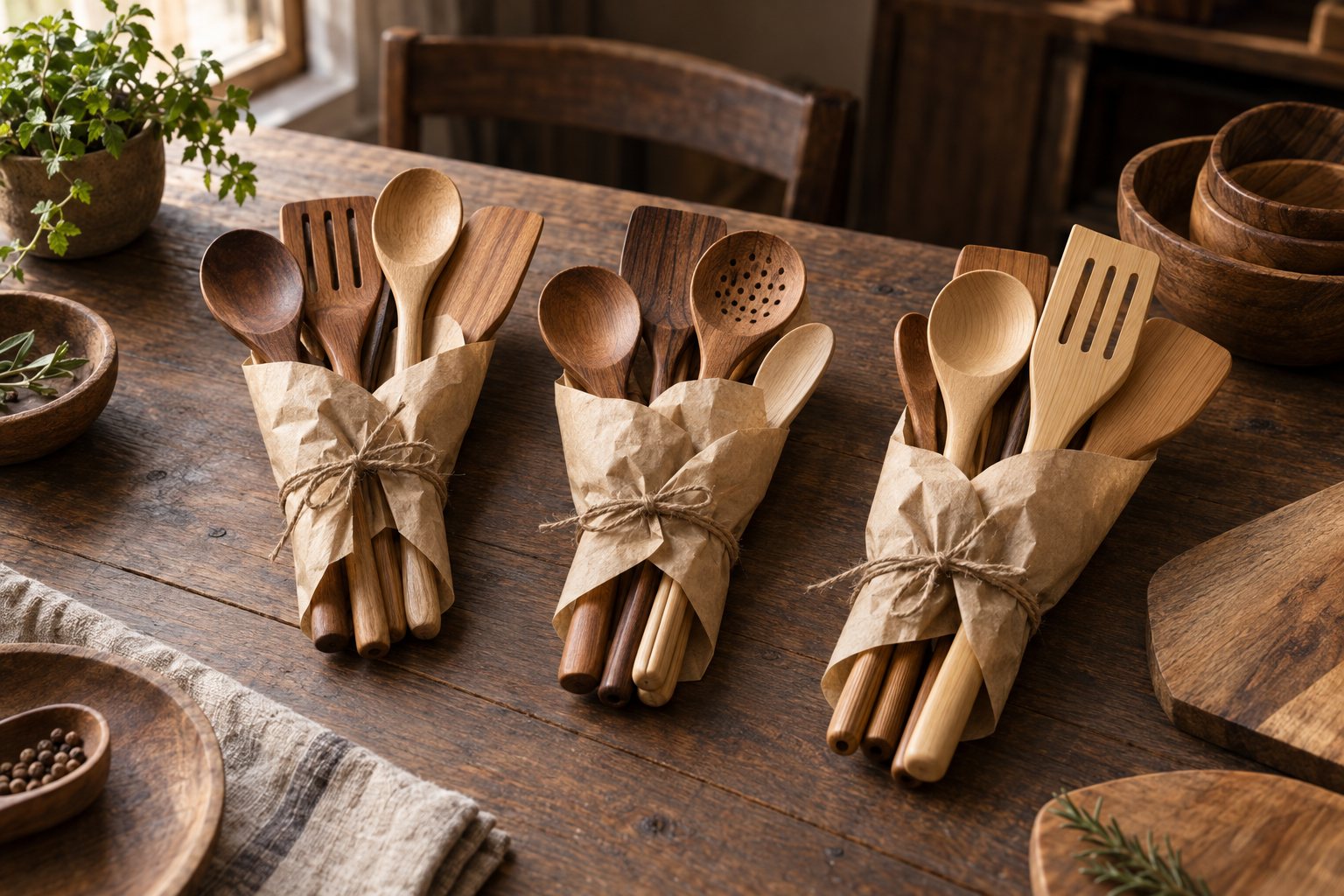
These three cases are illustrative. They are composites built from the situations wooden utensil buyers actually bring to a sourcing desk, with no client names, no invented sales figures and no testimonials. What they show is the chain of decisions: how one early choice, a species, a stock shape, a packaging format, determines the MOQ, the sampling path and the calendar that follow. The only numbers used are the reference ranges published on our MOQ and lead time page, and every figure in a real program is confirmed in writing before a deposit is paid.
Case 1: A kitchenware brand launches a teak set
The buyer runs a kitchenware brand with an established cookware line and wants a five-piece wooden utensil set that photographs as premium. The program starts from the species decision: teak, for its warm brown tone and dark striping, its dense, oily feel in the hand and its strength as the most-searched species in the category. Program shape follows: five stock shapes, a solid spoon, a slotted spoon, a spatula, a salad server pair and a spoon rest, rather than custom silhouettes, because stock shapes avoid master carving entirely and keep the entry point at the low end of the reference range, typically from about 500 pcs per style, confirmed in writing.
Branding is a laser-engraved mark on each handle plus a printed sleeve and a care card. The sampling path is therefore short: a stock sample in about 3-5 working days to approve species and finish, then an engraving proof to fix mark size, depth and position. The approved engraved piece becomes the golden sample. Bulk runs typically 30-45 days after sample approval, and the spec sheet carries the species and origin basis information the brand's customs broker needs for the plant-product declaration. The species reasoning is expanded on our teak wood utensils page. What makes this route work is restraint: stock shapes and one branding method keep the calendar at reference speed while the engraving and sleeve carry the brand.
Case 2: A cookshop builds beech basics with reorders
The buyer owns a cookshop with a strong local following and wants open-stock wooden tools sold individually, so customers can build their own sets. Beech is the species decision, chosen for its pale, even grain and its low piece-to-piece variation, which keeps shelf displays consistent and photography simple, and for its position as the workhorse behind the classic wooden spoon. The program lists solid spoons in two sizes, a slotted spoon, a spatula and a corner spoon, all stock shapes, all priced and stocked individually. The first order sits at the stock-shape reference MOQ, about 500 pcs per style confirmed in writing, with simple banded packaging and a shared hang tag.
The point of this case is the second order. Because the shapes are stock, the golden sample is on file and the artwork is approved, a reorder skips sampling entirely and goes straight into a production window, subject to the calendar at the time. The cookshop plans reorders ahead of its busy gifting season, placing them with the full 30-45 day bulk reference range and transit in mind. Over time the line extends, a wooden utensil holder here, a spurtle there, each added as its own style. This is the quiet compounding advantage of a basics program, and it is the pattern most wholesale wooden utensils buyers settle into; our wholesale page and the beech wood page cover the details.
Case 3: A corporate gift program with engraved acacia sets
The buyer is a promotional products agency assembling a thank-you gift for a client company's program: a three-piece acacia set, solid spoon, spatula and honey dipper, in a gift box, with the recipient company's logo engraved on each handle. Acacia is chosen for its bold striped grain and warm tones, which read as generous in a gift context, with the variation piece to piece marketed honestly as part of the material's character. The engraving is the other company's logo, so the artwork proof round matters double: mark size, depth and position are approved on a physical proof before anything runs.
The calendar is built backwards from the event date: transit, then the 30-45 day bulk reference range, then the custom sample round of about 7-15 working days, then artwork review. The gift boxes, sleeve cards and care cards are produced by packaging suppliers with their own minimums per design, confirmed separately from the utensil MOQ. Mixed routing, acacia pieces from the belt's warmer-toned workshops and boxes from a packaging supplier, is coordinated by the desk so everything converges at packing. This shape of program, with its packaging emphasis, is expanded on our corporate wooden gifts page, and the material notes are on the acacia wood page.
The three routes, side by side
| Aspect | Case 1: brand teak set | Case 2: cookshop beech | Case 3: corporate acacia |
|---|---|---|---|
| Species | Teak | Beech | Acacia |
| Shapes | Five stock shapes | Open stock, all stock | Three stock pieces |
| Branding | Laser-engraved logo | Shared hang tag | Engraved recipient logo |
| Packaging | Printed sleeve, care card | Banded, hang tag | Gift box, sleeve, care card |
| Sampling path | Stock sample plus engraving proof | Stock sample | Custom sample plus engraving proof |
| Calendar driver | Bulk reference range | Reorder timing | Event date, planned backwards |
What the cases teach together
Read as a set, the cases show one pattern: the more decisions that come from existing masters and approved proofs, the shorter and calmer the calendar. Case 2 never leaves stock territory and reorders almost conversationally. Case 1 adds one branding layer and accepts one proof round for it. Case 3 adds packaging with its own supplier minimums and an external deadline, which is manageable precisely because it is planned backwards. Wherever your program sits on that spectrum, the desk will quote it in the same units, per style, with reference ranges and written confirmation. If you can see your program in one of these rows, send the brief and we will tell you which parts of the route apply and which do not. For the longer arc of building a branded line, our note on starting a wooden utensil brand picks up where these cases end.