Why buyers ask this question
The question arrives from two directions at once. Retail customers ask whether a wooden utensil will shed anything into their food, and retail buyers ask what they can honestly write on a product page without overclaiming. Both concerns are answerable with facts rather than badges, and this page sets out the material story the way it can be defended: what solid wood is, what food-contact oil finishes do, what is deliberately avoided, and which documents a buyer should request before writing marketing copy of their own.
What the material actually is
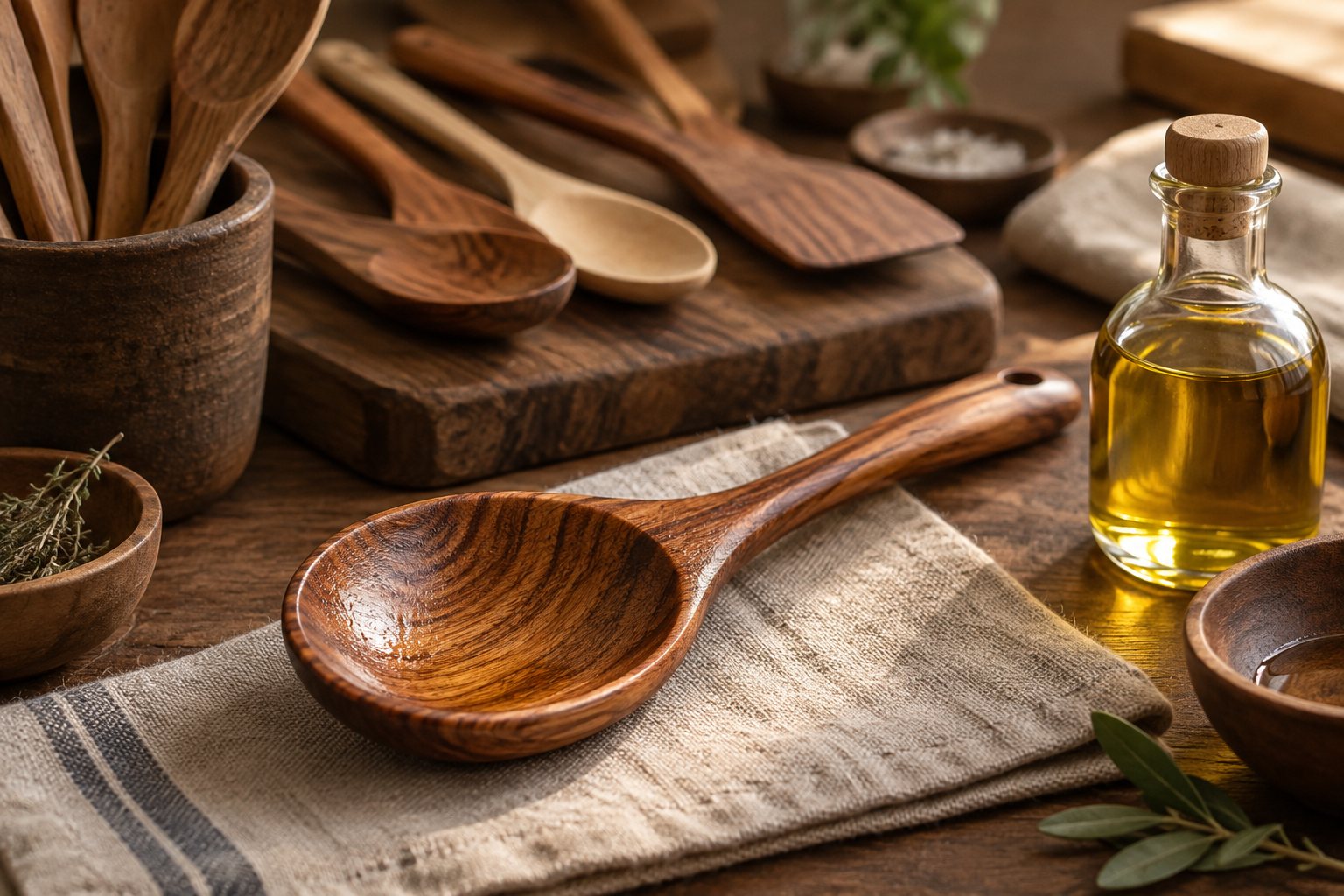
A quality wooden kitchen utensil is a solid piece of wood, shaped from the blank: bandsawn or carved into form, turned on a lathe where the handle is round, and sanded through successively finer grits to a smooth touch. There is no coating between the wood and the food. The finish is an oil, commonly mineral oil, sometimes blended with beeswax or supplied as a walnut-oil blend, that penetrates the surface and can be renewed by the user. That renewability is the structural point of the system: the finish is not a layer that can peel, because it is not a layer at all, it is treated wood.
The deliberate avoidance matters as much as the choice. Lacquer-type film finishes are generally avoided on cooking surfaces because, as films, they can chip, and a chipped film ends up where nobody wants it. Buyers should confirm the finish system in writing for every program, and treat any proposal that puts a hard film on a cooking surface as a question to resolve before sampling, not after.
What non-toxic can and cannot mean
The phrase has no single certified standard behind it in this category, so the honest approach is descriptive rather than declarative. Described factually, a wooden utensil finished with a food-contact oil is a product with a short, understandable ingredient list: one species of wood and an oil intended for food contact. That description is checkable, because each element can be documented. What the phrase cannot carry is a certification claim, because there is no certificate named after it to hold, and regulators in the United States police unsubstantiated claims through the FTC Green Guides framework, which asks that environmental and safety language be qualified and matched to what the product actually is. Our guidance is simple: describe the wood, name the finish, and let documentation do the persuading. The long-form version of this argument sits in our note on the claim itself.
| Finish system | What it is | What buyers confirm |
|---|---|---|
| Mineral oil | The common food-contact oil; penetrates and is renewed by the user | Named on the spec sheet; care copy matches |
| Mineral oil with beeswax | Oil blended with beeswax for a slightly protected feel | Blend ratio and feel approved on the golden sample |
| Walnut-oil blend | A plant-based oil finish option | Allergen note for nut oils agreed for packaging |
| Film finishes (lacquer-type) | Hard surface coatings that can chip | Generally avoided on cooking surfaces; if proposed, resolve before sampling |
Documentation to request
Three documents turn the story into a file a compliance adviser can work with. First, the finish specification: which system, on which species, in writing. Second, the regulatory context: in the United States, wood food-contact articles must be clean, and finishes for food contact fall under the FDA food-contact substance rules in the 21 CFR 174-186 range, so the finish should be identified well enough to be assessed against that framework. Third, where the destination market needs it, German LFGB expectations are the stricter food-contact framework EU buyers often reference; test reports where held are confirmed per program rather than promised in the abstract. California Proposition 65 warning obligations depend on finishes and adhesives, and buyers assess that with their own adviser. Our compliance page walks the full import picture, including the Lacey Act declaration that names the species for US entry.
One allergen line deserves its own mention: walnut-oil finishes are a genuine option, and nut-oil allergen labeling is a packaging decision to make early, not a surprise to catch in review. The allergen note covers it, and the choice between mineral oil and walnut oil is compared in the finishes comparison.
Bamboo and composite honesty
Bamboo utensils are often swept into the same conversation, and they deserve a sharper question: bamboo is a fast-renewing plant, but finished bamboo panels involve adhesives, so buyers should ask which adhesive system a panel uses and what documentation carries it, and any green claim must match that reality under the Green Guides. Solid-wood programs sidestep the adhesive question entirely, which is one reason they anchor the material story for brands that lead with simplicity. The trade-offs are set out in the bamboo guide.
None of this asks a buyer to choose between warmth and diligence. The solid-wood program is the simpler story precisely because its claims are checkable, one species, one oil, and documents for both. That checkability is what retail buyers usually mean when they ask for non-toxic wooden utensils: not a badge on the box, but a material file they can read, quote on their own product page, and defend to their customers without qualifying language.
What to send the desk
- The destination market, so the documentation list matches it.
- The species and the finish preference, or an open brief with your position.
- Whether claims language review is needed for your packaging copy.
- Quantities per style; stock shapes typically start from about 500 pcs per style, confirmed in writing.
The material story is the easiest part of a wooden program to get right and the easiest to overstate. Send a brief and the desk will return the species, finish and documentation list in one written reply.