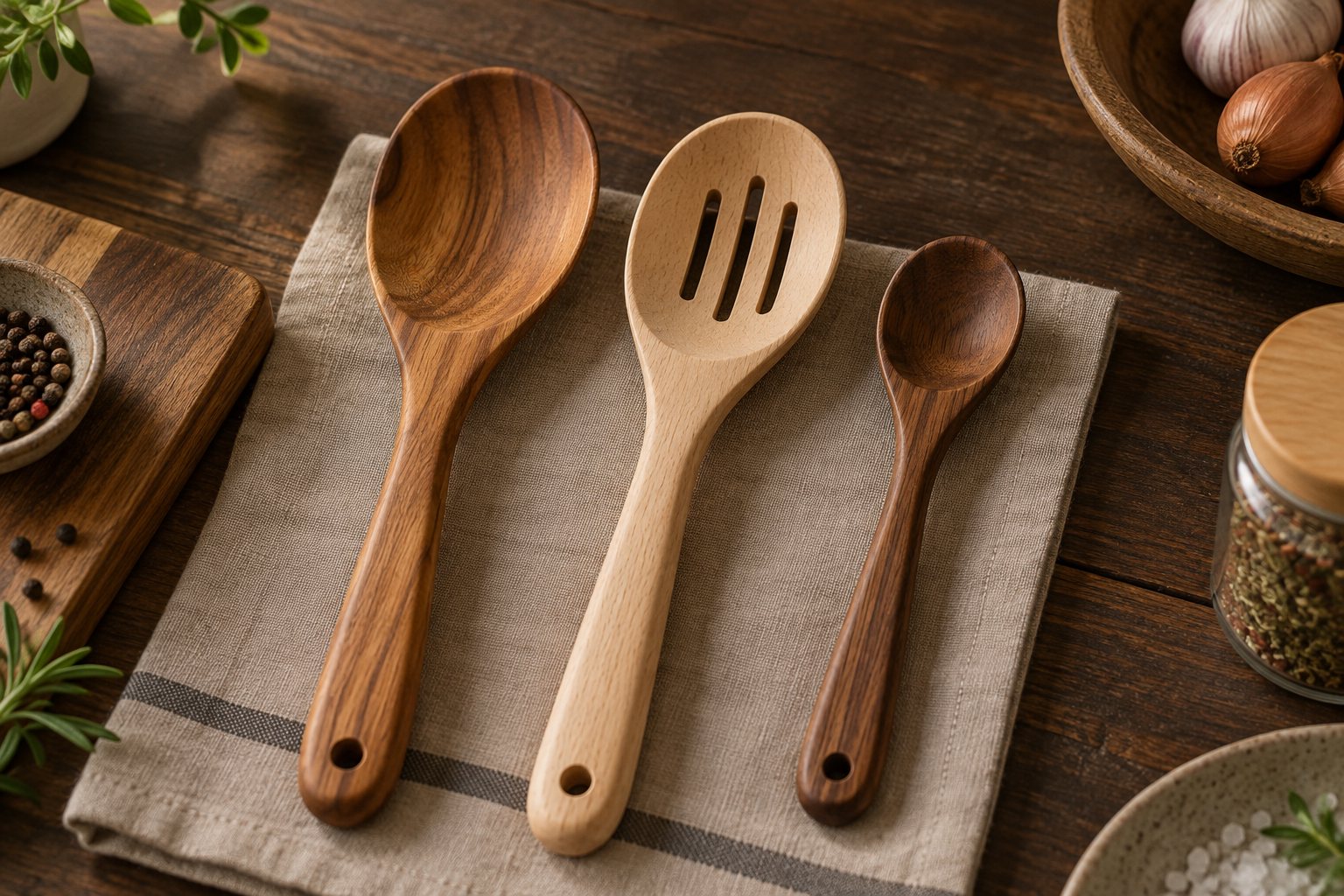
The spoon is where programs start and where they fail
Every wooden spoon wholesale program begins with the same object, and most disagreements about quality end on it too. A spoon that stirs awkwardly, splashes from a shallow bowl or balances badly in the hand will be named in reviews no matter how good the rest of the set is. So spoon selection deserves more attention than any other shape decision, and it starts with understanding the three families and what each is for.
We coordinate spoon programs across several species and dozens of existing workshop patterns, which means a buyer can usually assemble a range from stock bowls and handles before paying for any custom carving. The levers below are the ones that actually move how a spoon performs and how it sells.
The three families
| Type | Bowl and edge geometry | Typical woods | Role in a program |
|---|---|---|---|
| Solid spoon | Round or oval bowl, shallow to medium depth, smooth pouring edge | Beech, teak, acacia, olive wood | The anchor; stirring, serving and tasting in one piece |
| Slotted spoon | Oval bowl with slot or holes; slimmer lip for draining | Beech, teak, acacia | Lifting from liquid; the practical second spoon |
| Corner spoon | Pointed bowl corner that reaches pan edges and jar bottoms | Beech, olive wood | Specialty add-on that justifies a wider set |
| Jar spoon | Narrow, tall bowl sized for deep jars | Beech, olive wood, rubberwood | Niche piece for condiment and preserve lines |
| Tasting spoon | Small bowl, long handle, often single-piece | Beech, teak | Professional-kitchen crossover piece for cookshop buyers |
Bowl depth and what it changes
Bowl depth is the quiet spec. A shallow bowl feeds tasting and sauce work but splashes when stirring a full pot; a deep bowl carries soups and stews but drinks sauce instead of spreading it. Depth also interacts with species: a dense, oily teak bowl can be carved thinner without feeling fragile, while a lighter beech bowl keeps more thickness for stiffness. We check bowl depth against the intended job during sampling, because a photograph cannot convey it and a spec number alone does not settle the argument. The practical approach is to approve depth with a filled-pot test, not a drawing.
Handle length, balance and comfort
Handle length for cooking spoons commonly runs roughly 10-13 in as common options, confirmed on the spec sheet for each piece. Length is only half the story, though; balance decides whether the spoon feels alive or clumsy. A handle that is turned on a lathe can carry a swell where the grip lands, and the transition from handle to bowl should have no hard shoulder where food dries or a hand catches. Ergonomic notes belong on the spec sheet with the artwork, not in the product description after the fact. For shorter serving spoons and salad-style pieces, table reach replaces pot depth as the controlling measure.
Species picks for spoon programs
Beech is the workhorse: pale, hard, fine and even in grain, and it machines cleanly into almost any bowl shape, which is why it anchors value and kids lines. Teak is the premium pick, dense and naturally oily with warm brown tone and dark striping, and it is the most-searched species in our keyword data. Acacia brings bold striped grain that varies piece to piece, strong in gift channels with a golden sample agreed. Olive wood delivers dramatic swirl grain in smaller blanks, best for single-piece carved spoons and jar spoons. Walnut reads premium at the table. Species details sit in the teak and beech guides.
Branding a spoon
The handle end is the natural home for a logo. Laser engraving is the common branding method because it burns a durable, natural-looking mark with no ink on a food-contact surface, and it is usually flexible on stock designs with new artwork setup confirmed per program. Placement and size are settled on the artwork proof before production. See the engraving guide for the proof workflow.
Slotted spoons and the draining test
Slotted spoons look like a solid spoon with holes, and that description sells them short. The slot changes the tool's whole posture in the pot: it lifts without carrying half the braising liquid, it drains vegetables against the pan edge, and it doubles as the tasting spoon for saucy work. When we sample slotted spoons, we check the slot edges as carefully as the bowl, because a slot cut with rough interior walls is the one place splinters hide that a fingertip test on the outer surface will not find. Interior sanding of slots is part of the standard splinter and sanding checks, and it is worth asking to see the check, not just its result. Slot pattern, a single long slot or a group of holes, is a spec choice: the long slot drains faster, the holes hold small food back better, and either is confirmed on the spec sheet with the sample.
Serving sizes and kids lines
Two extensions reuse the same patterns cheaply. Serving spoons scale the bowl up and move the handle length toward the table, and they inherit the golden sample of the cooking line so tone stays consistent across a brand. Kids lines scale everything down, round the bowl edges further, and lean on beech for its pale, even look; sizing and safety notes for that channel are collected in our kids' utensils note. Both extensions are usually minor modifications of existing patterns rather than new carvings, which keeps them inside stock-shape MOQ references and lets a range grow one SKU at a time. Handle comfort across sizes is covered in the ergonomics note.
What to send the desk
- Reference spoons or photos, marked stock or custom per silhouette.
- Species, or tone and retail position if species is open.
- Bowl depth intent: stirring, serving, tasting or jar work.
- Handle length range, as common options within roughly 10-13 in for cooking tools.
- Quantity per style and engraving intent.
Spoon specifications are settled fastest with physical samples in hand. Request a sampling plan and the desk will propose stock patterns that come close before any custom work is discussed.