What a set has to do before it looks good
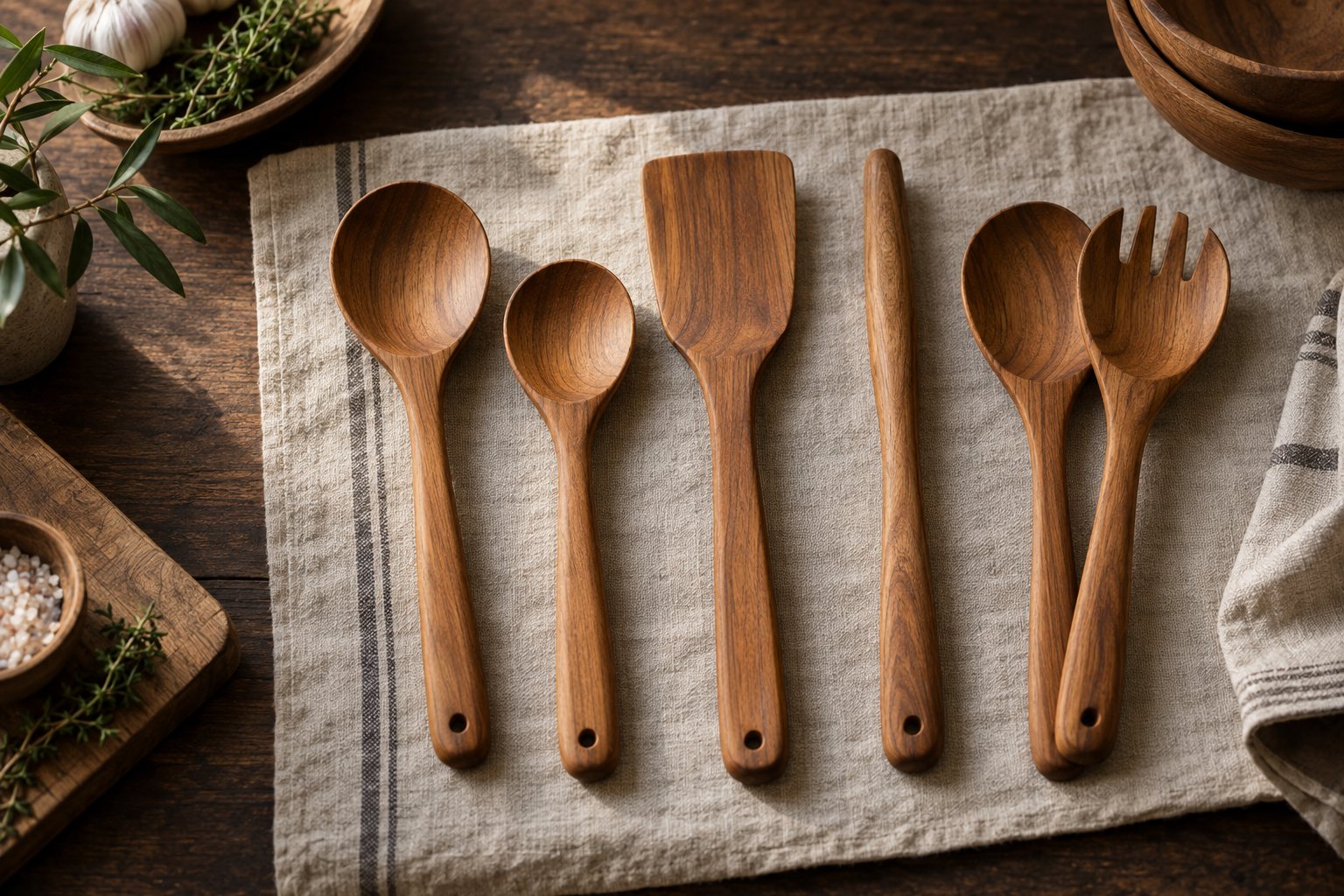
A wooden utensil set is bought once but judged daily. The buyer who unpacks it expects the pieces to cover real cooking, not to complete a photogenic lineup. So composition starts with a functional audit: which pieces does one cook reach for across a week? A solid spoon for stirring, a slotted spoon for lifting, a spatula for pan work, and something specialty, a corner spoon or a spurtle, to give the set a reason to exist. That is the functional core from which almost every successful set is built, and the packaging then tells the story of why those five pieces belong together.
Wholesale buyers carry a second question on top: how does the set behave as a unit of commerce? It has to photograph as one product, survive a drop test in its retail box, and sit at a price point the channel supports. Composition, species and packaging solve those three problems together, which is why we treat set design as a sourcing decision rather than a catalog pick.
Common set sizes and how they are built
| Pattern | Typical composition | Role in a range | What buyers confirm |
|---|---|---|---|
| 3-4 piece starter | Solid spoon, slotted spoon, spatula, optional corner spoon | Entry price point, gift-with-purchase, promo channels | Piece list, species, sleeve or tag packaging |
| 5-6 piece core set | The starter plus a specialty piece and a spoon rest or scraper | The main retail unit for most brands | Box style, insert layout, care card |
| 7 piece full set | Core plus tongs or pasta server, often with a holder | Premium single-SKU position | Holder inclusion, carton strength |
| 12-14 piece range | Full kitchen coverage: several spoons, spatulas, server pair, ladle, holder | Flagship or holiday box, housewarming gifting | Two-box or split carton design, assembly time |
The sizes shown are conventions, not rules. Common sets run 3-7 pieces, and published ranges on the market include 4-, 5-, 12- and 14-piece sets. What matters is that each added piece earns its slot: a set that grows from five to twelve pieces without new functions just raises the retail price and the shipping weight at the same time.
Stock sets versus custom sets
Stock-based programs
A stock set assembles existing workshop shapes into a new combination. The carving masters already exist, so sampling is fast, quality is predictable, and the MOQ stays low: stock designs typically start from about 500 pcs per style, confirmed in writing for each program. Most first programs should live here. The brand value comes from the combination, the species and the packaging, none of which require new tooling. Our MOQ and lead time page shows how the counting works.
Custom compositions
A custom set introduces at least one new silhouette, perhaps a proprietary handle profile or a shaped holder. Fully custom shapes typically start at 1,000+ pcs per style, because master carving and process tuning are amortized across the order. Mixed sets take the higher number on the custom piece only, not across the whole set, which is the most common misunderstanding we correct in first quotations. A useful middle path is to keep every tool stock and make only the holder or the box custom, so the shelf presence reads bespoke while the order stays mostly stock.
Pairing species inside one set
Species pairing is a quiet lever. A single-species set in teak reads premium and photographs with almost no tonal argument between pieces. A mixed set, beech tools with an acacia holder, trades some uniformity for cost control and a two-tone story on the shelf. Walnut or olive wood pieces lift a set into gift territory, and rubberwood keeps an entry set honest on price. The choice interacts with packaging photography, because grain and tone vary piece to piece in solid wood; programs define acceptable variation against an approved golden sample rather than treating it as a defect. Species characteristics are covered in the wood library, with deeper guides for teak and beech.
Tone matching decides how the set photographs, which decides how it sells online. Programs built on beech photograph with almost no tonal argument between pieces; acacia and walnut sets photograph richly but vary, so the packaging photography is shot from production pieces rather than prototypes. Whichever way the species mix leans, the golden sample defines the acceptable range before bulk begins, and the product page copy describes variation in the same words. Consistency between what the page shows and what the carton contains is a check we run on every set program, not a marketing afterthought.
Packaging and retail presentation
Packaging decisions start with the channel. A cookshop set wants an open box that shows the grain; an e-commerce set wants a close-fitting carton that survives parcel networks; a gift set wants a printed sleeve, a debossed hang tag and room for a care card. Every packaging element has its own supplier minimums and its own lead time, which the desk confirms in writing per program alongside the tools. Buyers who plan packaging with the first sample round, rather than after production, avoid the most common schedule slip. The private label page covers branding and box options in detail.
What to send for a set quotation
- The piece list, marked stock or custom per shape.
- Species per piece, or one species with a stated retail position.
- Set size and whether a holder or spoon rest is included.
- Packaging intent: open box, printed sleeve, gift carton, hang tags.
- A quantity range per set, and the in-warehouse date.
With those five lines, the desk can return a per-style MOQ, a sampling plan and a species recommendation in one written reply. Send the set brief when it is ready.