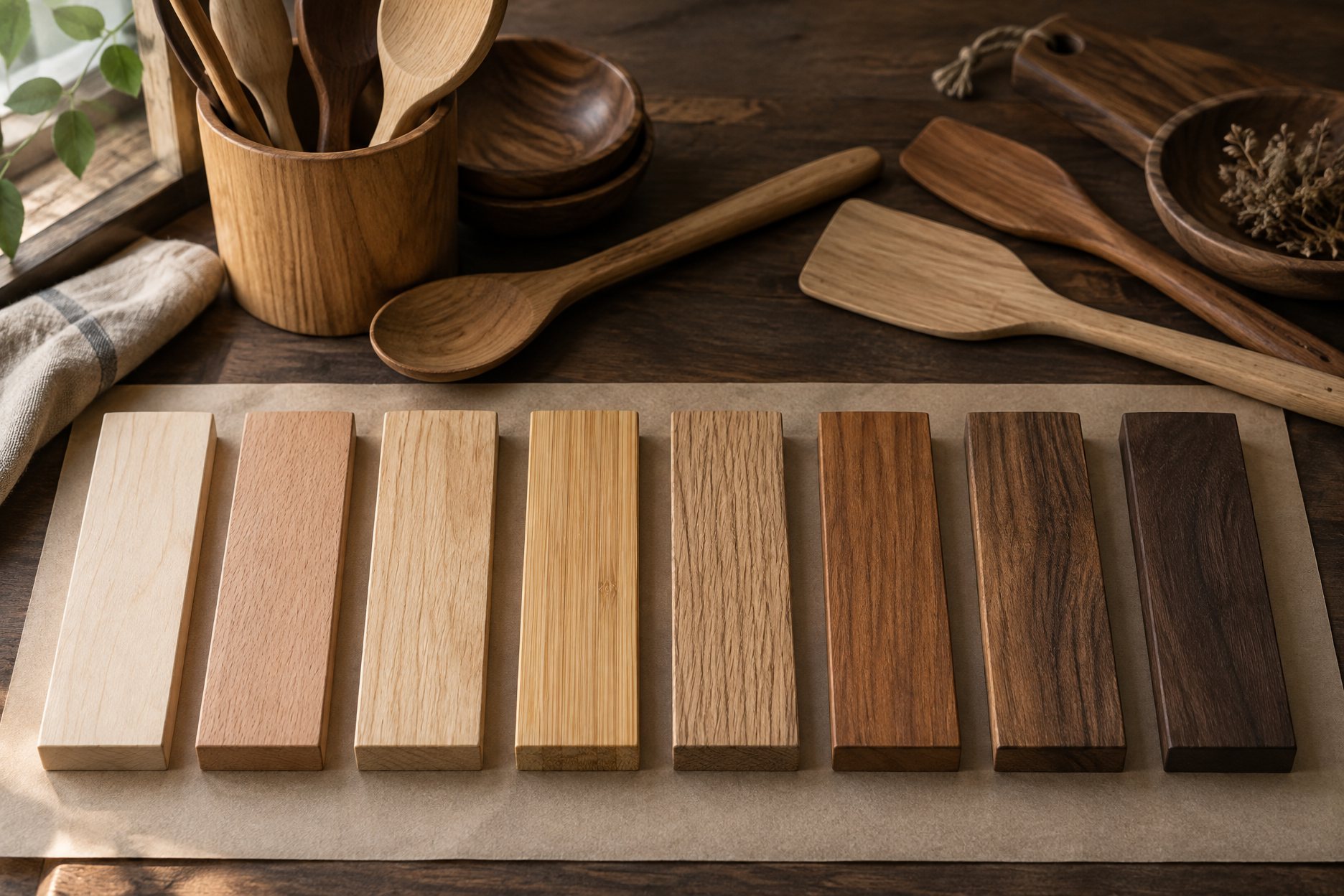
What makes a wood good for kitchen tools
A wood suits the kitchen when it combines density with a tight enough grain to feel smooth, behaves predictably around water, carries no strong odor or taste, and carves cleanly enough to hold a crisp edge on a spoon bowl. Every species in this library passes that basic bar; what differs is where each one sits on tone, variation, supply and price position, and those differences are exactly what a program decision turns on. Descriptions here stay qualitative on purpose: performance in your market depends on the finish system, the piece design and the care story as much as on the species, and all three are fixed on the spec sheet, not in a table on a website.
The ledger
| Species | Character for kitchen tools | Notes for buyers |
|---|---|---|
| Teak | Dense, oily, water-resistant; warm brown tone with dark grain | The most-searched species in our keyword data; plantation-grown in Southeast Asia |
| Beech | Hard, fine, even grain; pale color, takes light finishes well | Common European hardwood; the workhorse for spoons and spatulas |
| Oak | Prominent open grain; strong and heavier | Pronounced grain shows character; sealing awareness belongs in the program spec |
| Walnut | Rich dark brown, smooth grain, premium look | North American or European supply; premium price position |
| Acacia | Distinct striped grain; dense and water-resistant | Popular for warm-toned sets; grain varies piece to piece |
| Olive wood | Dramatic swirl grain; aromatic | Premium, often single-piece carved items; supply in smaller sizes |
| Rubberwood | Light color, even texture | Plantation hardwood byproduct; common in value programs |
| Bamboo | Technically a grass; hard, light, striped look; usually laminated strands | Panel making requires adhesive, so ask which adhesive system and what documentation the panel carries |
Teak
Teak is the premium anchor of the category: dense, naturally oily and water-resistant, with a warm brown tone and darker striping that photographs beautifully. The natural oils give it a smooth, substantial hand feel and help it resist water uptake, which suits tools that live near the sink. Plantation-grown supply from Southeast Asia is the commercial route. Programs choose teak to justify a premium retail position, and accept the trade: it sits at the top of the common species range on cost. Finishing behavior differs on oily species, so the finish system is confirmed on the spec sheet. The program view is on our teak wood utensils page.
Beech
Beech is the pale, fine-grained hardwood behind the classic wooden spoon: hard, with an even grain that carves cleanly and a consistent color that keeps a production run looking uniform. It takes light oil finishes well and keeps photography predictable, which simplifies both quality control and your product pages. Common supply runs through European hardwood channels. Beech rarely carries a premium story on its own, and that is not its job; it is the species for basics lines, open stock, kids' pieces and promotional programs where consistency and value discipline matter most. Program notes are on the beech wood utensils page.
Oak
Oak brings a prominent open grain and a heavier, strong body, and its pronounced figure reads as character on serving pieces. The open grain is also the specification point: it calls for thorough sealing awareness in the program spec, because an open-structured surface behaves differently around moisture and finish than a tight-grained wood. For buyers, oak suits boards, servers and statement pieces where the grain is the visual argument, and it rewards a buyer who writes the finishing and care spec carefully rather than assuming a generic oil treatment.
Walnut
Walnut is the premium dark option: rich brown, smooth-grained and visually quiet in a way that reads as refined next to bolder woods. Supply comes from North American or European channels, and its price position is premium accordingly. Walnut suits a top-tier line or a two-tone set design, walnut handles with a paler bowl, and it pairs well with minimal packaging that lets the material speak. Because it is darker, surface scratches and oil sheen show differently than on pale species, which is worth reflecting in the photography and care copy.
Acacia
Acacia is the character option: dense, water-resistant, with bold striping that contrasts lighter sapwood against deep brown heartwood. No two pieces look alike, which is its selling point in gift channels and its operational challenge on a shelf set. Programs built on acacia should agree a golden sample early and ideally shoot packaging photography from production pieces rather than prototypes, so the range customers receive matches the range they were shown. The full program treatment, including how to market the variation honestly, is on the acacia wood utensils page.
Olive wood
Olive wood has the most dramatic surface in the library: swirling grain, warm honey tones and a natural aromatic character. Blanks come in smaller sizes, which shapes the program: olive suits single-piece carved items, smaller tools and pieces where the swirl is the point, rather than long uniform utensils. Supply is premium and less uniform than the volume species, so programs treat olive as a halo line within a range rather than as the workhorse of it.
Rubberwood
Rubberwood is the value program's species: light in color, even in texture and economical, because it is a plantation hardwood byproduct of Southeast Asia's rubber industry. Its evenness machines cleanly and keeps a run consistent, and it takes a light finish well. It does not carry an exotic story, so programs position it on everyday usefulness rather than on material romance, which it supports honestly and at a friendlier cost position.
Bamboo
Bamboo is technically a grass, not a wood, and it behaves like an engineered material in practice: hard, light and visually striped, usually laminated from strands into panels before shaping. The lamination is the buyer's question to ask: panel making requires adhesive, so programs should ask which adhesive system a panel uses and what documentation it carries, a question covered in our note on bamboo utensil adhesives. Bamboo suits value-to-mid lines and eco-positioned programs when the claims are kept factual; the material page is here.
Natural variation and the golden sample
Grain, color and shade variation between pieces is natural in solid wood, and it is not a defect. It is managed with the golden sample: a physical piece you approve before bulk that defines the acceptable range of variation for the whole run. Species differ in how wide that range is, low for beech, wide for acacia and olive, and knowing that before you approve packaging photography is the difference between a smooth launch and a returns conversation. Our note on grain and color variation shows how to set customer expectations.
How to choose
- Fix the retail position. Premium story points to teak, walnut or olive; everyday value points to beech or rubberwood; gift character points to acacia.
- Decide the uniformity requirement. If every unit must look alike on a shelf or product page, favor the even species.
- Check supply against your sizes. Longer tools need longer, wider blanks, and premium species in large sizes carry sourcing time.
- Approve on your species. Sample, finish and golden sample should all be judged on the species you will actually ship, and reference figures for the resulting program are confirmed in writing; the framework is on the MOQ and lead time page.
If the choice is between the three most common species, our direct comparison of teak, acacia and beech settles it quickly. For the deeper criteria, start with what makes a wood good for cooking utensils and our guide to choosing a species for your program, then send a brief and the desk will recommend a species with reasons against your quantity and position.